Showing posts with label Ancient Egypt. Show all posts

Sunday, September 2, 2018

Egypt says archeologists have unearthed one of the oldest villages ever found in the Nile Delta, with remains dating back to before the pharaohs.

The Antiquities Ministry said Sunday the Neolithic site was discovered in Tell el-Samara, about 140 kilometres (87 miles) north of Cairo. Chief archaeologist Frederic Gio says his team found silos containing animal bones and food, indicating human habitation as early as 5,000 B.C.

That would be some 2,500 years before the Giza pyramids were built.

In recent years, Egypt has touted discoveries in the hopes of reviving tourism after the unrest that followed its 2011 popular uprising.

Egypt says village found in Nile Delta predated pharaohs

3,500 years ago, a woman might have done much the same thing to find out if she was pregnant as she would today: take a urine sample and wait patiently for a chemical reaction.

A papyrus from ancient Egypt instructs a woman to pee into a bag of barley and a bag of emmer (the variety of wheat cultivated by ancient Egyptians), according to a researcher at the University of Copenhagen, who is studying the document.
"If they grow, she will give birth. If the barley grows, it is a boy. If the emmer grows, it is a girl. If they do not grow, she will not give birth," reads the text, written in a hieratic script -- the ancient Egyptians' cursive form of Hieroglyphic writing -- and dated to the New Kingdom era, sometime between 1500 and 1300 BC.
The birth prognosis, which was first translated by a Danish Egyptologist in 1939, is just one example of a large collection of ancient Egyptian papyri belonging to the University of Copenhagen, acquired by grants from the Carlsberg Foundation. Of the 1,400 papyri, a tiny proportion are medical texts, most of which have remained untranslated.

"We're dealing with the kind of material that is so incredibly rare," says Egyptologist Kim Ryholt, head of the Carlsberg papyrus collection and part of the international research collaboration translating the texts. "There's less than a dozen well-preserved ancient Egyptian medical papyri... Anything new will shed important new light."

Promising new insights
Translation is a long process. "The texts are damaged, they are written in an ancient script that few people can read, and the terminology is immensely complex," says Ryholt. c
The wheat and barley test was already known from a papyrus of a similar date that is now held at the Egyptian Museum of Berlin. However, there have been other revelations since the research collaboration began in September 2017.
Until now, many Egyptologists thought that the civilization was unaware of the existence of the kidneys, but one of the translated medical texts discusses the organ, showing that their knowledge of anatomy was even more advanced than previously thought.

Other papyri include various treatments for eye diseases, such trichiasis, when the eyelashes grow inwards toward the eye. The papyrus prescribes mixing the blood of a lizard, a bull, a female donkey and a female goat, and inserting the concoction into the eye.

Sofie Schiødt, one of the PhD students analyzing the texts, suggests that there may have been a standardized medical corpus containing tests and treatments used across ancient Egypt. But she urges caution, as the small number of papyri and the uncertainty as to where they came from geographically means that it is hard to say exactly how representative the texts are.
Transmission of knowledge
One thing is for sure, the pregnancy testing method had longevity. "We find the same test in Greek and Roman medicine, in the Middle East during the Middle Ages, and European medical traditions," says Schiødt. The test appears as late as the 1699, in a book of German folklore.
In the ancient world, Egyptian medicine was highly respected and their methods were often adopted by other cultures, explains Andreas Winkler, an Egyptologist from the University of Oxford.
"Ancient travelers to Egypt were amazed at the fact that there were doctors specializing in particular areas of medicine and their knowledge was praised," he says. "As the pregnancy test shows, it is clear that certain techniques found their ways beyond the shores of the Nile."

Scientific accuracy
Not only did the method stand the test of time, it may also have some scientific substance. According to an article published in the journal Medical History in 1963, researchers tested the theory and found that in 70% of the cases, the urine of pregnant women did cause the grain to sprout. The test was deemed unreliable for predicting the sex of the children, however.

Modern scholars have attributed the test's accuracy to the high levels of estrogen in a pregnant woman's urine, which helps to stimulate growth in the wheat and barley.
So, did ancient Egyptian doctors know about hormones in urine?
"No," says Schiødt, "any idea of hormonal influences is completely non-existent." Instead, she suggests that the test's accuracy is probably down to trial and error.
Other pregnancy tests attested in Egyptian papyri were less reliable. Winkler tells of the onion test that advises inserting an onion in the vagina of a woman, and if her breath smelled like onions the next day, it meant she was pregnant.
"It's difficult to put our idea of rational, scientific medicine onto what they were doing," says Schiødt.
Ancient Egyptian medicine was grounded in religious or mythological stories and pharmaceutical remedies were aimed to expunge spirits or demons from the body, she says. So, while they recognized diseases similar to those today, the treatments can't be compared.

Ancient Egyptian medical knowledge revealed by 3,500-year-old texts

Tuesday, August 28, 2018

The cheese was found as a white mass in a broken jar. (Supplied: University of Catania and Cairo University)

Forget vintage, extra mature or barrel-aged — scientists believe they have found the world's oldest cheese in an Egyptian tomb...and it dates back to the 13th century BC.
According to a study published in ACS' journal Analytical Chemistry, ​the cheese was found in the tomb of Ptahmes, which was rediscovered in 2010.

The tomb of the former mayor of Memphis in Egypt was initially unearthed in 1885. After being lost under drifting sands, it was rediscovered eight years ago and archeologists found broken jars at the site a few years later.

One jar contained a solidified whitish mass, as well as canvas fabric that might have covered the jar or been used to preserve its contents. 

After dissolving the sample, the researchers purified its protein constituents and analyzed them with liquid chromatography and mass spectrometry.

The peptides detected by these techniques show the sample was a dairy product made from cow milk and sheep or goat milk. The characteristics of the canvas fabric, which indicate it was suitable for containing a solid rather than a liquid, and the absence of other specific markers, support the conclusion that the dairy product was a solid cheese.

Dairy danger
However, eating may not have been advisable, even back then. Other peptides in the food sample suggest it was contaminated with Brucella melitensis​, a bacterium that causes brucellosis. This potentially deadly disease spreads from animals to people, typically from eating unpasteurized dairy products. If the team's preliminary analysis is confirmed, the sample would represent the earliest reported biomolecular evidence of the disease.

Prior to this, the earliest evidence of cheese-making in the archaeological record dates back to 5500 BC, in what is now Kujawy, Poland, where strainers with milk fats molecules have been found. Cheesemaking may have begun independently of this by the pressing and salting of curdled milk to preserve it.

The research was supported by the Italian Ministry of Education, University and Research​, the University of Catania​ and Cairo University​.

World's oldest cheese confirmed in Egyptian tomb

Monday, August 27, 2018

Egypt’s Antiquities Ministry announced that an Egyptian archaeological mission on Sunday has uncovered a Ptolemaic dynasty cemetery west of Alexandria.

Secretary-General of the Supreme Council of Antiquities, Mostafa Waziri said that the ministry is conducting excavation work in the region through an archaeological mission, supervised by the Director General for Alexandria Antiquities Khaled Abu al-Hamd.

Speaking to Al-Masry Al-Youm, Waziri said that the cemetery dates back to the third century BC, around 2,270 years ago.

Head of the Egyptian Antiquities Sector Ayman Ashmawy said that the mass graves carved in the rock were uncovered by the mission during excavation work. These graves are separate architectural units, each consisting of stairs leading to a small hall that may have been used as a rest for visitors, which leads into an open yard surrounded by the burial holes.
He added that it was likely that the tombs were belonged to poor people of the time, as the cemetery features layers of simple mortar with no fanciful decorations giving away high status.

According to Ashmaway, preliminary examinations revealed that architectural plans for some tombs were modified later, with certain burial holes being closed up, confirming that multiple generations used the cemetery.

Tableware used by the families of the dead during their visits was found alongside decorated lamps, Ashmaway said. Glass and pottery were also found, which were offerings for the deceased.

Archaeological team uncovers Ptolemaic cemetery west of Alexandria

Thursday, August 9, 2018

A second sphinx from the time of ancient Egypt has been discovered, after workers accidentally dug up the renowned artefact during road works.
Engineers came to a halt after stumbling upon the a large statue, which they described as having a "lion's body with a human head".

They soon realised they retrieved the world's second Egyptian sphinx, which originated as far as 2500 BC during the reign of the Pharoah Kafre in Egypt.

Mohamed Abel Aziz, the Director General of Antiquities, said the structure has yet to be removed from the ground, and remains embedded in soil until it can be properly excavated.


Members of the public can now visit the site where the sphinx was found, Antiquities Minister Khaled al-Anani said.

The Great Sphinx of Giza in Egypt is the largest and most famous sphinx in the world, and is situated at the Giza Plateau, on the west bank of the Nile River in Egypt.

It was carved from the bedrock of Giza plateau, made out of limestone, and is said to be one of the world's largest single-stone statues.

The ancient Egyptians regarded the sphinx as a symbol of royalty, and pharaohs would have their heads carved into stone which are then placed on their tombs.

This was known as a way to mark their relationships with Sekhmet, the solar deity, which was believed to be a lioness.

In late 2017, historians believed the Great Sphinx of Giza was an entrance to a secret underground city, which was concealed by Egyptian authorities.

Archaeologists also believe the sphinx sits on top of a complex network of tunnels with passages which leads to a massive underground metropolis.

Historian Gerry Cannon previously told Express.co.uk: “It was as if every living Egyptologist had lost interest in this wonderful underground metropolis, for all their articles during the ensuing years are centred more on tombs of queens and shafts that had been sunk deep into the ground to burial tombs.”

“Nobody knows what’s under there, no one has been able to investigate.

Egypt's second sphinx found: Ancient statue discovered during road works

Tuesday, July 31, 2018

An Egyptian-Australian mission from Macquarie University discovered the burial chambers of Middle Kingdom's two top officials in Upper Egypt's province of Minya, the Egyptian Ministry of Antiquities said Tuesday.

The discovery was accidently made while the team was cleaning the interior of a tomb at Beni Hassan necropolis in Minya, said Mostafa Waziri, secretary general of the Supreme Council of Antiquities.
The burial chambers of the two top officials Ramushenty and Baqet II date back to 4,000 years ago, as the Middle Kingdom in ancient Egypt's history covers the period between 2055 BC and 1650 BC.

Ayman Ashmawi, head of Ancient Egyptian Antiquities Department at the Ministry of Antiquities, said no funerary collection was found inside Ramushenty's main burial chamber, pointing out that it might have been removed by British Egyptologist Percy E. Newberry, who worked in Beni Hassan necropolis between 1893 and 1900.

Baqet II's burial chamber has the same design as that of Ramushenty's and its walls are decorated with well-preserved colored drawings.

A collection of food clay pots was found in two side burial chambers located to the east and west of Ramushenty's main chamber. Another collection of clay vessels was also found in Baqet II's chamber.

The Egyptian-Australian mission has been working in Beni Hassan necropolis in Minya since 2009.

Over the past couple of years, Egypt has witnessed several big archeological discoveries, including Pharaonic tombs, statues, coffins, mummies and burial sites, remains of a Roman-style Hellenistic gymnasium, ruins of a funerary garden, a pyramid's burial chamber and a huge statue believed to be of ancient King Ramses II.

Burial chambers of 2 ancient officials discovered in Upper Egypt's Minya

The Great Pyramid of Giza is steeped in history and mythology, and as such fascinates researchers from various fields who all want to unravel its many secrets.

Now, an international team of physicists has found that, under the right conditions, the Great Pyramid can concentrate electromagnetic energy in its internal chambers and under its base.

The results, which are published in the Journal of Applied Physics, could help scientists to create new nanoparticles—particles between 1 and 100 nanometers in size—that could be used, for example, to develop highly efficient solar cells or tiny sensors.

The team from ITMO University in Saint Petersburg, Russia, and the Laser Zentrum in Hannover, Germany, applied theoretical physics methods to investigate how the Great Pyramid responded to electromagnetic radiation—which includes radio waves, microwaves and infrared, visible light, ultraviolet light, X-rays and gamma rays.

INCREDIBLE ELECTROMAGNETIC DISCOVERY IN GREAT PYRAMID OF GIZA'S HIDDEN CHAMBERS

Saturday, July 28, 2018

The unsettling red liquid pooled around three decomposed mummies found inside a 2000-year-old burial chamber in the historic port city of Alexandria in Egypt has taken on a life of its own.

Horrifying images of a trio of skeletons floating in the murky soup led to rumours the “mummy juice” contained medicinal or supernatural properties, with locals anxious to bottle the stuff.

Others feared its odd colouring signified the presence of a metal such as mercury.

The large, black granite sarcophagus was unearthed in the Sidi Gaber district earlier this month and cracked open despite fears that doing so would unleash an ancient curse.

The General Secretary of the Supreme Council of Antiquities, Dr Moustafa Waziri dismissed early speculation the tomb could contain the remains of Alexander the Great, saying instead it may have belonged to a priest.

However, the discovery of possible arrow damage to one of the skulls means the bones probably belonged to military officials, according to a statement released by Egypt’s Ministry of Antiquities yesterday.
Authorities also revealed the liquid was neither “juice for mummies that contains an elixir of life” nor “red mercury” but something far more pedestrian — sewage water.

But the ugly — or in this case — smelly truth has failed to scare off the believers, even inspiring an online campaign.

A change.org petition entitled “let the people drink the red liquid from the dark sarcophagus” has attracted more than 16,000 signatures.

“We need to drink the red liquid from the cursed dark sarcophagus in the form of some sort of carbonated energy drink so we can assume its powers and finally die,” petition founder Innes McKendrick wrote by way of explanation.

Workmen found the black granite tomb five metres underground during construction of an apartment building in the historic Mediterranean port city.

Scientists identify mystery liquid in Egyptian sarcophagus

A team of archaeologists — led by Yale Egyptologist John Darnell — has uncovered a “lost oasis” of archaeological activity in the eastern Egyptian desert of Elkab.

The researchers from the Elkab Desert Survey Project — a joint mission of Yale and the Royal Museums of Art and History Brussels working in collaboration with the Ministry of Antiquities and the Inspectorate of Edfu — surveyed the area of Bir Umm Tineidba, once thought to be devoid of any major archaeological remains. Instead, the team unearthed “a wealth of archaeological and epigraphic material,” says Darnell, including a number of examples of ancient rock art or “graffiti,” the burial site of an Egyptian woman, and a previously unrecorded, enigmatic Late Roman settlement.
John Darnell, professor of Egyptology at Yale, along with a team of researchers, uncovered a “lost oasis” in the eastern Egyptian desert. One image dates back to about 3,300 B.C.E. and includes large depictions of animals, including an addax, or antelope. “The large addax in particular deserves to be added to the artistic achievements of early Egypt,” says Darnell.

One particularly impressive image identified during the field season, says Darnell, dates back to about 3,300 B.C.E. and includes large depictions of animals, including a bull, a giraffe, an addax (antelope), a barbary sheep, and donkeys. Other tableaux depict long lines of boats, revealing an “interesting mixture of Eastern Desert and closer, Nile Valley-oriented styles,” notes Darnell.

“At a time immediately before the invention of the hieroglyphic script, rock art such as this provides important clues to the religion and symbolic communication of Predynastic Egyptians,” says Darnell. “The large addax in particular deserves to be added to the artistic achievements of early Egypt.

Darnell says that this ancient graffiti was created for other people who would visit the site or who might pass along the road. “The ancient Egyptians just loved to write and draw,” he says. “And this general desire to express and memorialize yourself graphically seems to be one of the real hallmarks of Egyptian culture; it seems to be one of the things that you pick up when you are Egyptianized: that you just can't pass one of these surfaces without memorializing yourself.”

Egyptians chose a meaningful spot to carve these images, explains Darnell, usually at a habitation site or, as in this case, a crossroad of tracks going east to west. 

I think this discovery will influence how we see the development of the early state in Egypt.
-john darnell

“This is imagery and style that you would expect in the Nile Valley, but it's out here in the Eastern Desert at this site,” says Darnell, explaining that the drawings suggest a cultural mix and demonstrate that desert people were almost certainly interacting with Nile Valley people. “It shows a greater complexity and a little bit more of a mosaic, or hybrid of groups,” says Darnell. “I think this discovery will influence how we see the development of the early state in Egypt.”

“Our newly discovered material at Bir Umm Tineidba is important in revealing a desert population coming under increasing influence from the Nile Valley during the time of Dynasty 0 [the Protodynastic Period in ancient Egypt characterized by an ongoing process of political unification, culminating in the formation of a single state to begin the Early Dynastic Period],” he adds.

The archaeologists also uncovered several burial tumuli — or mounds of earth and stone raised over graves — that appear to belong to desert dwellers with physical ties to both the Nile Valley and the Red Sea. They investigated one of the tumuli, which they determined was the burial place of a woman between 25 to 35 years of age at the time of her death. “She was probably one of the local desert elite, and was buried with at least a strand of Red Sea shells and carnelian beads, alluding to her desert and Red Sea associations, as well as a Protodynastic vessel of Nile Valley manufacture, all indicative of the two worlds of Nile and desert with which she and her people appear to have interacted,” says Darnell.

To the south of the rock inscription and tumuli sites, the archaeologists located a Late Roman settlement with dozens of stone structures. The ceramic evidence and other materials indicate that the site dates to between 400 and 600 C.E., says Darnell. “This Late Roman site complements the evidence for similar archaeological sites in the Eastern Desert, and once again fills a gap in an area once blank on the archaeological map of the Eastern Desert.

“Probably associated with the ancient people whom Egyptian and later Roman documents call the Blemmyes, these sites reveal important information on the late administration of the Eastern Desert, and help us understand the transition between the Late Antique and the Early Islamic Periods,” says Darnell.

To document their findings in the field, the team used a digital technique developed at Yale in 2010, in collaboration with Yale digital archaeologist Alberto Urcia. The technology, employing the photogrammetirc Structure from Motion technology, generates detailed three-dimensional models of the rock surface that are used to produce high-resolution images of each panel. Unfortunately, says Darnell, considerable and active mining in the area is threatening the sites in and near Bir Umm Tineidba.

The new technology, says Darnell, cuts excavation and recording time down to about a quarter of what it used to be. “It means you get through more material in greater detail than you would otherwise. If you’re racing the clock to record these desert sites before mining and land reclamation and thieves get at them, you know you can do four structures in a month rather than one structure in a month, which is fabulous.”

Darnell adds, “If I could go back in time and do all the other sites I’ve done in the past using that technique I would. At least we have it now, and it will greatly increase the speed and accuracy with which we will hopefully record ever more sites.”

source:
https://www.yale.edu/

Ancient Egyptian graffiti, burial sites discovered by Yale archaeologists

Thursday, September 21, 2017

Detailed images aid efforts to learn about ancient Egyptian life, dinosaur brain development
The mummified remains of a 7-month-old baby enter a CT scanner at Washington University School of Medicine.

The mummified remains of a 7-month-old baby boy and pieces of skull from two teenage Triceratops underwent computed tomography (CT) scans Saturday, Sept. 16, at Washington University School of Medicine in St. Louis, in hopes researchers could learn more about their ancient pasts. The project is a collaboration between the Saint Louis Science Center and the School of Medicine.


By scanning the child mummy, researchers hope to gain insight into the diet, lifestyle, habits and physiology of people living in Egypt around 2,000 years ago, when the baby was mummified. They also are looking for clues to how the baby died.

The braincases of two juvenile Triceratops were scanned to better understand how the creatures’ brains developed over their lifetimes. Dinosaur brain development is one part of a larger story of how the brain developed and evolved over the ages.
A baby mummy (above) and pieces of skull from two Triceratops underwent computed tomography (CT) scans at Washington University School of Medicine in St. Louis on Saturday, Sept. 16. The mummy and the skulls belong to the Saint Louis Science Center. See more scans and photos below.


Radiologists from the university’s Mallinckrodt Institute of Radiology — Sanjeev Bhalla, MD, Vincent M. Mellnick, MD, and Michelle Miller-Thomas, MD — teamed up three years ago to scan three mummies from Washington University’s Kemper Art Museum and the Saint Louis Art Museum. Their findings will be included in an upcoming permanent exhibit at the museum that focuses on the art of ancient Egypt.

This time, they hope to apply their knowledge to the study of a rare baby mummy. Geetika Khanna, MD, chief of pediatric radiology, will help interpret the scans, which were taken at the Center for Advanced Medicine on the Medical Campus.
“Drs. Bhalla, Khanna and I will be predominantly studying the scans of the body cavity to see if there are any recognizable tissues or any signs of disease,” Mellnick said. “But we may not be able to say how the baby died, unless it is something obvious like broken bones. Many of the internal organs are gone, which is what you need for diagnosis.”

The child mummy has been part of the Science Center’s collections since 1985, when it was donated by the relatives of a man who acquired it on a trip to Egypt in the late 19th or early 20th century. Decades ago, someone cut away the wrappings around the shoulders, leaving the mummified baby’s head exposed.

A previous scan performed at the School of Medicine about 10 years ago showed four amulets, or fragments of amulets, nestled deep within the wrappings, but with the technology at that time, it was impossible to see whether they bore any patterns or symbols.

The new scan of the child mummy took only a minute, and researchers from the Science Center and the School of Medicine crowded around computer monitors to see the initial results. To everyone’s surprise, a fifth amulet – possibly a heart scarab amulet – was visible inside the chest cavity near where the heart once was. It was too early to say whether it had been placed inside the baby’s chest deliberately or had fallen into the body over the centuries. The team expects to learn more about the amulets and the skeleton as they study the images.

The mummy scan over, a small piece of Triceratops skull was delivered to the CT scanner next. The skull of an adult Triceratops can be up to 8 feet long, but the animal’s brain is only inches in length. The brain doesn’t fossilize, but the braincase contains a small cavern in the bone — the brain cavity — near where the skull meets the spine. Mapping indentations and ridges on the cavity’s inner walls can give clues to the structure of the brain.

Within a few minutes, the braincases of Bruce, a young Triceratops found by Science Center researchers in 2010, and Lost Creek Trike, found in 2016, were scanned. Both are from the Hell Creek Formation near Jordan, Montana, and date to 66 million to 67 million years ago.

loading...

Ashley Morhardt, PhD, an assistant professor of neuroscience who studies dinosaur brain development and evolution, could barely contain herself. The scans look like high-resolution 3-D photographs, every detail visible.

“Oh my gosh, let me at it!” Morhardt cried. “Look at that! That’s beautiful!”

From the scans, Morhardt will be able to produce a 3-D endocast of the inside of the brain cavity in the skull. While the soft tissues rotted away long ago, channels in the bone remain where blood vessels and nerves once passed, and the shape of the brain cavity reflects the structure of the brain it once housed.

“I can use the endocast as a road map for reconstructing the size and shape of the brain based on what we know about modern-day dinosaurs – aka birds – and their relatives, alligators and crocodiles,” Morhardt said. “From there, we can compare brain models across different life stages and species of dinosaurs to see through time how brain and brain regions evolved and what that might have implied for behavior.”

loading...

Scans of baby mummy, dinosaur skulls offer clues to ancient pasts

Sunday, September 10, 2017

The tomb of a royal goldsmith containing the mummies of a woman and her two children was recently discovered in Egypt. It is believed that the tomb is over 3,000 years old.

        HOT ON THE WEB

Researchers in Egypt recently unearthed the over 3,000-year-old tomb of a royal goldsmith containing the mummies of a woman and her two children. It is estimated that the ancient tomb located near the city of Luxor dates back to the 16th to 11th centuries BC. The local authorities believe that the tomb belonged to Amenemhat, who was a goldsmith for the god Amun.
According to the Egyptian mythology, Amun was the most powerful god during the same period. It is believed that the discovery of the royal goldsmith’s tomb could lead to additional discoveries in the area.

Archaeologists have estimated that the woman died when she was in her 50s after suffering from a bacterial bone disease. Her children were in their 20s and 30s at the time of their deaths. “We found a lot of equipment buried inside and around the tomb including mummies, coffins, death masks, jewelry and a statue,” Egypt’s Minister of Antiquities Khaled el-Enany said. “Our work is not finished yet.”
“I believe, with the help of God, that we will soon start the required digs in the area,” he added. “And if we are lucky, we will find four more tombs.”

Newly unearthed ancient tomb with mummies unveiled in Egypt

Thursday, August 31, 2017

Ancient Egypt will be showcased at Milan's Museum of Cultures (MUDEC) from September 13 until January 7, 2018.

The exhibition, entitled 'Egypt. The Extraordinary Find of the Pharaoh Amenhotep II', centers on the life of the pharaoh, from 1427 until 1401 BC.

Son of the important Thutmose III, Amenhotep II has long been overshadowed by his famous father.

The documents relating to the discovery of his tomb in the Valley of the Kings by archaeologist Victor Loret in 1898 were also unknown until about 15 years ago. The documents are now the property of the Milan University, which keeps them in the Egyptian Studies Archives, and will be exhibited for the first time ever to the public.

The exhibition will include a life-size reconstruction of the columned pharaoh's tomb, with the immersive experience continuing into a mortuary chamber in a section focusing on funerary beliefs and mummification.

The precious objects that were laid to rest with the pharaoh to "accompany him into the afterlife" will be on display. The archaeologist Loret brought to light the pharaoh's mummy as well as those of some other well-known rulers of the New Kingdom, which were hidden inside one of the four rooms annexed to the mortuary chamber in an attempt to keep them safe from tomb raiders. Tutankhamon's mother and grandmother were both among the bodies found.

Ancient Egypt goes to Milan with Amenhotep II exhibit

Monday, August 28, 2017

Languages not seen since the Dark Ages have come to light after scientists used a new method to inspect a trove of ancient manuscripts found in a monastery in Egypt.

They turned up extremely rare tongues, including Caucasian Albanian, on documents they found in Saint Catherine’s monastery on the Sinai peninsula that date back 1,500 years.

Monks originally wrote their texts down on parchments which were later scrubbed off and used to write the Bible by future generations who spoke in more modern languages.

But a new technique developed by researchers allows them to see the original text hidden from the naked eye in a development hailed as “new golden age of discovery”.

Researchers took photographs of the material using different parts of the light spectrum and put the electronic images through a computer algorithm.

The method allows them to see the first writing laid down on the parchments, which at the time were highly valuable, before they were re-used in later years.

It comes as the chances of finding further ancient documents in St Catherine’s monastery comes under threat by Muslim extremists, including Isis, who are known to destroy Christian sites.

“The age of discovery is not over,” Michael Phelps from the Early Manuscripts Electronic Library in California told The Times.

“In the 20th century new manuscripts were discovered in caves. In the 21st century, we will apply new techniques to manuscripts that have been under our noses. We will recover lost voices from our history.”

The site beneath the mountain where God is said to have revealed the Ten Commandments to Moses has collected thousands of manuscripts since it was built in the 6th century.

“I don’t know of any library in the world that parallels it,” said Mr Phelps. “The monastery is an institution from the Roman Empire that continues operating according to its original mission.”

He added that although the site stored ancient knowledge for future generations the practice by monks of re-using parchments meant they were also to blame for erasing it.

“At some point the material the manuscript was on became more valuable than what was written on it,” Mr Phelps said. “So it was deemed worthy of being recycled.”

But scientists are now busy digging out the original texts found in the recent trove of manuscripts discovered in St Catherine’s, which was announced by the Ministry of Antiquities in Cairo.

The find includes the first-known copy of the gospels in Arabic and the earliest examples of known works from the Greek physician Hippocrates.

Scientists find languages not used since Dark Ages among ancient manuscripts recovered from monastery

Thursday, August 17, 2017

One tomb from Ptolemaic-era burial shaft carved into the bedrock, another a child's grave: This was not an army camp

Three tombs dated to the Ptolemaic Period, more than 2,000 years ago, have been discovered in the Nile Valley, the Egyptian antiquities ministry said on Wednesday. The discovery was made in an area called al-Kamin al-Sahrawi, south of Cairo.

The discovery of sarcophagi and clay fragments suggests that the archaeologists found a major necropolis used over generations. It was evidently used sometime between the 27th Dynasty (when ancient Egypt was under Persian control, from 525 B.C.E. to 404 B.C.E.) and the subsequent Ptolemaic period.

A burial shaft carved out of the bedrock in one of the tombs leads to a chamber where four sarcophagi with anthropoid lids, containing two women and two men, were found.

Another tomb contains two chambers, one with six burial holes, including one for a child. Excavation on a third tomb is still underway, the ministry stated.

Since women and children were buried there, the necropolis is unlikely to be part of an ancient military site, as had been previously suggested, postulate the archaeologists.
Sarcophagi in cemetery dating back about 2,000 years in the al-Kamin al-Sahrawi area in Minya province, south of Cairo.AFP Photo / Egyptian Antiquities Ministry

The 27th Dynasty had been founded by the Persian emperor Cambyses II, son of Cyrus the Great. Cambyses II conquered Egypt in 525 B.C.E., wresting control from the unfortunate and short-lived pharaoh Psamtik III. He tried to continue onto Libya, to no avail. 

The Greco-Roman Ptolemaic period began in 305 B.C.E. when the Roman general Ptolemy assumed the title of King, dubbing himself Ptolemy I Soter, i.e., the Savior. His dynasty would rule Egypt for over three centuries: male rulers took the soubriquet Ptolemy, while the queens tended to be named Arsinoe, Berenice and, famously, Cleopatra.

Archaeologists discover tombs from ancient 'great cemetery' in Egypt's Nile Valley

Wednesday, July 5, 2017

Archaeologists in Israel have uncovered treasure and 3,200 year-old bodies at what is said to be the site of the Biblical city of Gezer, believed to have been destroyed in a devastating raid by the ancient Egyptians.

Excavations of the city appeared to show how three inhabitants, two adults and a child, met a violent end after a series Egyptian pharaohs attempted to bring Gezer to heel, finally reducing it to rubble in the 13th Century B.C., Haaretz reported.

In one large building—some 20 by 15 meters in size—in the south of the city, archaeologists discovered the three skeletons, two still with earrings in their ears.

Meanwhile, the debris inside the room gave an indication of final, traumatic hours of the trio's life.

It appeared that a large room where two of the inhabitants, one of the adults and the child, had been set on fire before they were crushed by the collapsing ceiling and buried in a meter-thick layer of debris.

The ferocity of the blaze was such that the sex and origin of the pair, whether Egyptian of Canaanite, could not be discerned and some of the bones had been reduced to dust. 

"The adult was lying on its back with arms above its head. The child, who was wearing earrings, was next to the adult, to the left. This room was filled with ash and collapsed mud brick,” Professor Steven Ortiz of the Tandy Institute for Archaeology at Southwestern Baptist Theological Seminary, said.

“We can only guess what they were doing in the building on the eve of destruction. Were they hiding? Were they fleeing the Egyptian soldiers? Did they go back into the building to retrieve valuables?”

In a second room, to the north of where the pair died, a third body also showed signs of a grisly end. Buried by stones, the body had been largely preserved. 

“This individual attests to the violent nature of the destruction, as it is clear he experienced the trauma of the event,” Ortiz said.

Among the Egyptian jewellery that was discovered was a 13th century amulet and various scarabs and cylinder seals. The amulet bears the cartouches—or official royal monikers—of the Egyptian Pharaohs Thutmose III and Ramses II.

Gezer was a prominent Canaanite city-state throughout the 2nd millennium B.C. It’s location between Egypt and Mesopotamia gave it a strategic trade and military position.

The death of Ramses II led to rebellion in the southern Levant and Gezer was sacked in order to subdue the Canaanites. Several other sites in the area including Jaffa, Gerisa and Aphek were also destroyed.

Archaeologists in Israel have uncovered treasure and 3,200 year-old bodies at the Biblical city of Gezer

Wednesday, April 19, 2017

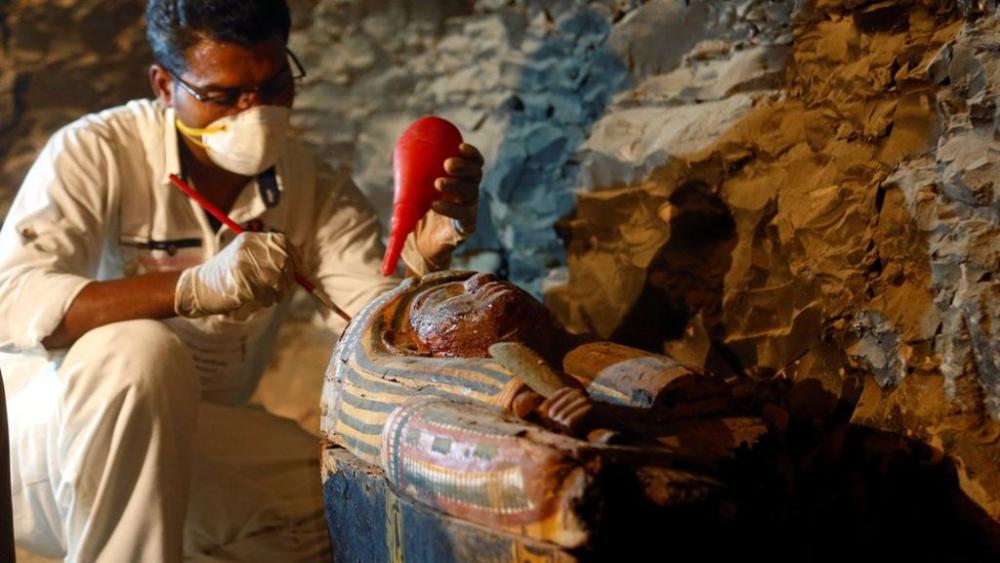
Egyptian archaeologists have discovered six mummies, colourful wooden coffins and more than 1,000 funerary statues in a 3,500-year-old tomb near the southern city of Luxor, the antiquities ministry said Tuesday.

The tomb, discovered in the Draa Abul Nagaa necropolis near the famed Valley of the Kings, belonged to a nobleman who worked as the city judge, the ministry said in a statement.


Six mummies discovered in ancient tomb near Egypt's Luxor

Wednesday, April 5, 2017

A 3,800-year-old pyramid found with an alabaster block bearing the name of pharaoh Ameny Qemau has been discovered at the site of Dahshur in Egypt.


Another pyramid containing artifacts bearing the name of Ameny Qemau (also spelled Qemaw) was discovered in 1957 in Dahshur, a royal necropolis in the desert on the Nile River's west bank. The finding has left Egyptologists with a mystery as to why the same pharaoh seemingly has two pyramids to his name.

The remains of the pyramid's inner structure were discovered by a team of Egyptian archaeologists and announced today (April 4) by the Egyptian Ministry of Antiquities.
This block was found within the 13th dynasty pyramid in Egypt and bears the name of pharaoh Ameny Qemau, who ruled about 3,800 years ago.
Credit: Egyptian Ministry of Antiquities

Within the inner structure, the team discovered an alabaster block containing 10 lines of hieroglyphic writing. The ministry said it had not yet deciphered the writing on the block.

 Both James Allen, a professor of Egyptology at Brown University, and Aidan Dodson, a research fellow at the University of Bristol, said  that inscribed on the block is a type of religious text used to line the walls of pyramids, and that it bears the name of the pharaoh Ameny Qemau.

"He was the fifth king of Dynasty XIII and ruled for about two years, [around] 1790 B.C.," Allen said.

Thomas Schneider, a professor of Egyptology and Near Eastern studies at the University of British Columbia, also agreed that the name of the pharaoh on the hieroglyphic inscription is Ameny Qemau. "The resolution of the photo is not very good; however, I believe I can read the name of Ameny Qemau," he said.


Dodson, who co-authored a 1998 paper on the artifacts from the Qemau pyramid discovered in 1957, noted the peculiarity of two pyramids holding the pharaoh's name.

Why both pyramids would have artifacts bearing the name of the same pharaoh is a mystery, Dodson said. Perhaps, the newly found pyramid doesn't actually belong to Ameny Qemau, but rather to one of his predecessors, he said. Along that line of thinking, perhaps upon rising to power, Qemau chiseled out the name of his predecessor on the block and inserted his own name instead, Dodson said. The hieroglyphic symbols representing the name of Ameny Qemau are of poor quality, indicating that the carver had to inscribe them over a chiseled-out area, Dodson added.

"Why Ameny Qemau would have added his name is unclear, as Ameny Qemau's actual pyramid was found in 1957," Dodson said.

The antiquities ministry said in a statement that excavations of the pyramid are not yet complete and that "further excavation is to take place to reveal more parts."

2nd Pyramid Bearing Pharaoh Ameny Qemau's Name Is Found

Saturday, February 11, 2017

Monastir was founded on the ruins of the Punic–Roman city of Ruspina. The city features a well-preserved ribat that was used to scan the sea for hostile ships and as a defence against the attacks of the Byzantine fleet. Several ulema came to stay in the ribat of this peaceful city for contemplation. The ribat was, in the 1970s, also one of the filming locations for both the miniseries Jesus of Nazareth and Monty Python's Life of Brian.


A ribat (Arabic: رباط‎‎; ribāṭ, hospice, hostel, base or retreat) is an Arabic term for a small fortification as built along a frontier during the first years of the Muslim conquest of North Africa to house military volunteers, called the murabitun. 
These fortifications later served to protect commercial routes, and as centers for isolated Muslim communities. Ribats were first seen in the 8th century. The word "ribat" in its abstract refers to voluntary defense of Islam which is why ribats were originally used to house those who fought to defend Islam in Jihad. They can also be referred to by other names such as khanqah, most commonly used in Iran, and tekke, most commonly used in Turkey.

Classically, ribat referred to the guard duty at a frontier outpost in order to defend dar al-Islam. The one who performs ribat is called murabit. Contemporary use of the term ribat is common among Islamic militant groups such as al-Qa'ida or Islamic State of Iraq and the Levant.

The Ribat of Monastir
This is the oldest and most important defensive work to have been built along the North African coastline by the Arab conquerors in the early days of Islam.

Erected in 181 (796), the Monastir Ribat was enlarged on the north side in the Aghlabid period, and on the south side during the Fatimid era in 355 (966). After works carried out at the time of the Hafsids, indicated by a commemorative plaque dated 828 (1424), the fortress expanded to a surface area of 4,200 sq m. Many consolidations as well as several polygonal and circular towers were added between the 11th and 13th / 17th and 19th centuries in order to accommodate pieces of artillery.

The Monastir Ribat is a fortress flanked by circular and polygonal towers. The entrance porch is decorated with five flat niches framed by horseshoe arches. Over the niches there is a frieze of floral patterns, ornamentation typical of the Fatimo-Zirid style. A chicane door, over which is written a Hafsid inscription in the naskhi style, leads to a hallway giving access to the original ribat. The courtyard inside is flanked by porticoes, each leading into a cell. On the first floor is the prayer hall, which has two bays and seven naves. The central nave is wider than the others. This architectural layout, used for the first time in a prayer hall, was to become the norm in all the great Ifriqiyan mosques.

At the front of this area, on the first floor and on the south side, there is a room with seven naves and two bays, roofed with barrel vaults except for the central nave. The southern half of the central nave is covered by a flattened spherical dome with no pendentive. The indications are that this was a prayer hall whose mihrab was sealed off. Its architectural layout is reminiscent of the original ribat, which was situated exactly in line with this room. This building dates from AH 335 (AD 966) and was mentioned by the historian al-Bakri in the middle of the AH 5th century (AD 11th). Later it was used as a ribat for women.
Alteration works were carried out in AH 1115 (AD 1704) during which the ribat was given polygonal towers at the southeast and northwest corners and a circular tower at the northeast corner. These structures allowed adaptation to the military innovation of accommodating pieces of artillery. More towers, of which the bastions, were added during the works carried out by Husayn Bey between 1238 and AH 1250 (AD 1823–35). This explains the rather piecemeal aspect of the external walls, modifications to which extended from the AH 11th to the 13th centuries (AD 17th to 19th).

In the summer the Ribat houses various events that are part of the international festival of Monastir.


Source
"Réclamations, Suggestions." Nouvelair. Retrieved on 1 July 2010. "Nos Coordonnées Adresse : Zone Touristique Dkhila – 5065 – Monastir – Tunisie."
"Après le vol." Nouvelair. Retrieved on 1 July 2010.
Jacobs, Daniel and Peter Morris. The Rough Guide to Tunisia. Rough Guides, 2001. 215. Retrieved from Google Books on 1 July 2010. ISBN 1-85828-748-0, ISBN 978-1-85828-748-5.
"Portrait of Münster: Die Partnerstädte". Stadt Münster. Archived from the original on 2013-05-09. Retrieved 2013-08-07.
"Climate: Monastir – Climate graph, Temperature graph, Climate table". Climate-Data.org. Retrieved 21 July 2014.
"Monastir, Tunisia". Voodoo Skies. Retrieved 19 July 2014.

Ribat of Monastir, Tunisia

Thursday, January 5, 2017

King Ramses III was the second ruler of the Twentieth Dynasty, and the last of great pharaohs on the throne. Ramses III, son of Setnakht, ruled Egypt for 31 years. Shortly before his death, there was a conspiracy to kill him by several members of his household including one of his minor wives, Queen Tiy. 

It was essentially an attempt to ensure her son's ascending to the throne. The trial of this conspiracy is shown upon the walls of his mortuary temple at Madint Habu.
The tomb was begun by Setnakht, who then abandoned it and turned to KV14 where he was buried. Setnakht's son, Ramses III, then resumed work on KV11.


James Bruce was the first European traveler to enter this tomb in 1768. He was struck by the painted figures of the two blind harpists that he called it the Tomb of the Harpists.
Nowadays, the Tomb of Ramses III is considered one of the most visited tombs in the Valley of the Kings as there are many impressive reliefs and paintings to be seen on this tomb.


Tomb of Ramses III (KV11)

Friday, December 16, 2016

Usimare Ramesses III (also written Ramses and Rameses) was the second Pharaoh of the Twentieth Dynasty and is considered to be the last New Kingdom king to wield any substantial authority over Egypt. His long reign saw the decline of Egyptian political and economic power, linked to a series of invasions and internal economic problems.

Ramesses III was the son of Setnakhte and Queen Tiy-Merenese. He was probably murdered by an assassin in a conspiracy led by one of his secondary wives, Tiye, and her son Pentaweret.


Ramesses' two main names transliterate as wsr-mꜢʿt-rʿ–mry-ỉmn rʿ-ms-s–ḥḳꜢ-ỉwnw. They are normally realised as Usermaatre-meryamun Ramesse-hekaiunu, meaning "The Ma'at of Ra is strong, Beloved of Amun, Born of Ra, Ruler of Heliopolis".
Ramesses III's Mortuary Temple at Medinet Habu, Egypt

Tomb of Ramses III (KV11)


Genetics: Ramses III had haplogroup E1b1a

Ascension
Ramesses III is believed to have reigned from March 1186 to April 1155 BC. This is based on his known accession date of I Shemu day 26 and his death on Year 32 III Shemu day 15, for a reign of 31 years, 1 month and 19 days. Alternate dates for his reign are 1187 to 1156 BC.

In a description of his coronation from Medinet Habu, four doves were said to be "dispatched to the four corners of the horizon to confirm that the living Horus, Ramses III, is (still) in possession of his throne, that the order of Maat prevails in the cosmos and society".

Tenure of constant war
During his long tenure in the midst of the surrounding political chaos of the Greek Dark Ages, Egypt was beset by foreign invaders (including the so-called Sea Peoples and the Libyans) and experienced the beginnings of increasing economic difficulties and internal strife which would eventually lead to the collapse of the Twentieth Dynasty. In Year 8 of his reign, the Sea Peoples, including Peleset, Denyen, Shardana, Meshwesh of the sea, and Tjekker, invaded Egypt by land and sea. Ramesses III defeated them in two great land and sea battles. Although the Egyptians had a reputation as poor seamen, they fought tenaciously. Rameses lined the shores with ranks of archers who kept up a continuous volley of arrows into the enemy ships when they attempted to land on the banks of the Nile. Then, the Egyptian navy attacked using grappling hooks to haul in the enemy ships. In the brutal hand-to-hand fighting which ensued, the Sea People were utterly defeated. The Harris Papyrus states:

As for those who reached my frontier, their seed is not, their heart and their soul are finished forever and ever. As for those who came forward together on the seas, the full flame was in front of them at the Nile mouths, while a stockade of lances surrounded them on the shore, prostrated on the beach, slain, and made into heaps from head to tail.

Ramesses III claims that he incorporated the Sea Peoples as subject peoples and settled them in Southern Canaan, although there is no clear evidence to this effect; the pharaoh, unable to prevent their gradual arrival in Canaan, may have claimed that it was his idea to let them reside in this territory. Their presence in Canaan may have contributed to the formation of new states in this region such as Philistia after the collapse of the Egyptian Empire in Asia. Ramesses III was also compelled to fight invading Libyan tribesmen in two major campaigns in Egypt's Western Delta in his Year 5 and Year 11 respectively.


Economic turmoil
The heavy cost of these battles slowly exhausted Egypt's treasury and contributed to the gradual decline of the Egyptian Empire in Asia. The severity of these difficulties is stressed by the fact that the first known labor strike in recorded history occurred during Year 29 of Ramesses III's reign, when the food rations for the favoured and elite royal tomb-builders and artisans in the village of Set Maat her imenty Waset (now known as Deir el-Medina), could not be provisioned. Something in the air (possibly the Hekla 3 eruption) prevented much sunlight from reaching the ground and also arrested global tree growth for almost two full decades until 1140 BC. The result in Egypt was a substantial increase in grain prices under the later reigns of Ramesses VI–VII, whereas the prices for fowl and slaves remained constant.Thus the cooldown affected Ramesses III's final years and impaired his ability to provide a constant supply of grain rations to the workmen of the Deir el-Medina community.

These difficult realities are completely ignored in Ramesses' official monuments, many of which seek to emulate those of his famous predecessor, Ramesses II, and which present an image of continuity and stability. He built important additions to the temples at Luxor and Karnak, and his funerary temple and administrative complex at Medinet-Habu is amongst the largest and best-preserved in Egypt; however, the uncertainty of Ramesses' times is apparent from the massive fortifications which were built to enclose the latter. No temple in the heart of Egypt prior to Ramesses' reign had ever needed to be protected in such a manner.

Conspiracy and death
Thanks to the discovery of papyrus trial transcripts (dated to Ramesses III), it is now known that there was a plot against his life as a result of a royal harem conspiracy during a celebration at Medinet Habu. The conspiracy was instigated by Tiye, one of his three known wives (the others being Tyti and Iset Ta-Hemdjert), over whose son would inherit the throne. Tyti's son, Ramesses Amonhirkhopshef (the future Ramesses IV), was the eldest and the successor chosen by Ramesses III in preference to Tiye's son Pentaweret.

The trial documents  show that many individuals were implicated in the plot. Chief among them were Queen Tiye and her son Pentaweret, Ramesses' chief of the chamber, Pebekkamen, seven royal butlers (a respectable state office), two Treasury overseers, two Army standard bearers, two royal scribes and a herald. There is little doubt that all of the main conspirators were executed: some of the condemned were given the option of committing suicide (possibly by poison) rather than being put to death. According to the surviving trial transcripts, a total of three separate trials were started, while 38 people were sentenced to death. The tombs of Tiye and her son Pentaweret were robbed and their names erased to prevent them from enjoying an afterlife. The Egyptians did such a thorough job of this that the only references to them are the trial documents and what remains of their tombs.

Some of the accused harem women tried to seduce the members of the judiciary who tried them but were caught in the act. Judges who were involved were severely punished.

It is not certain whether the assassination plot succeeded since Ramesses IV, the king's designated successor, assumed the throne upon his death rather than Pentaweret, who was intended to be the main beneficiary of the palace conspiracy. Moreover, Ramesses III died in his 32nd year before the summaries of the sentences were composed, but the same year that the trial documents record the trial and execution of the conspirators.


Although it was long believed that Ramesses III's body showed no obvious wounds, a recent examination of the mummy by a German forensic team, televised in the documentary Ramesses: Mummy King Mystery on the Science Channel in 2011, showed excessive bandages around the neck. A subsequent CT scan that was done in Egypt by Ashraf Selim and Sahar Saleem, professors of Radiology in Cairo University, revealed that beneath the bandages was a deep knife wound across the throat, deep enough to reach the vertebrae. According to the documentary narrator, "It was a wound no one could have survived." The December 2012 issue of the British Medical Journal quotes the conclusion of the study of the team of researchers, led by Dr Zahi Hawass, the former head of the Egyptian Supreme Council of Antiquity, and his Egyptian team, as well as Dr Albert Zink from the Institute for Mummies and the Iceman of the European Academy of Bolzano/Bozen in Italy, which stated that conspirators murdered pharaoh Ramesses III by cutting his throat. Zink observes in an interview that:

"The cut [to Ramesses III's throat] is...very deep and quite large, it really goes down almost down to the bone (spine) - it must have been a lethal injury."
A subsequent study of the CT scan of the mummy of Ramesses III's body by Sahar Saleem revealed that the left big toe was likely chopped by a heavy sharp object like an ax. There were no signs of bone healing so this injury must have happened shortly before death. The embalmers placed a prosthesis-like object made of linen in place of the amputated toe. The embalmers placed 6 amulets around both feet and ankles for magical healing of the wound for the life after. This additional injury of the foot supports the assassination of the Pharaoh, likely by the hands of multiple assailants using different weapons. Before this discovery it had been speculated that Ramesses III had been killed by means that would not have left a mark on the body. Among the conspirators were practitioners of magic, who might well have used poison. Some had put forth a hypothesis that a snakebite from a viper was the cause of the king's death. His mummy includes an amulet to protect Ramesses III in the afterlife from snakes. The servant in charge of his food and drink were also among the listed conspirators, but there were also other conspirators who were called the snake and the lord of snakes.

The same study determined that the mummy of an unknown man buried with him was a good candidate for Ramesses's son Pentawer although it could not determine his cause of death. Both mummies shared Y chromosomal haplogroup E1b1a and 50% of their genetic material, which Zink stated "is typical of a father-son relationship."

In one respect the conspirators certainly failed. The crown passed to the king's designated successor: Ramesses IV. Ramesses III may have been doubtful as to the latter's chances of succeeding him, given that, in the Great Harris Papyrus, he implored Amun to ensure his son's rights.
Ramesses III's mummy

Legacy
The Great Harris Papyrus or Papyrus Harris I, which was commissioned by his son and chosen successor Ramesses IV, chronicles this king's vast donations of land, gold statues and monumental construction to Egypt's various temples at Piramesse, Heliopolis, Memphis, Athribis, Hermopolis, This, Abydos, Coptos, El Kab and other cities in Nubia and Syria. It also records that the king dispatched a trading expedition to the Land of Punt and quarried the copper mines of Timna in southern Canaan. Papyrus Harris I records some of Ramesses III's activities:

"I sent my emissaries to the land of Atika, [i.e., Timna] to the great copper mines which are there. Their ships carried them along and others went overland on their donkeys. It had not been heard of since the [time of any earlier] king. Their mines were found and [they] yielded copper which was loaded by tens of thousands into their ships, they being sent in their care to Egypt, and arriving safely." (P. Harris I, 78, 1-4)

Ramesses began the reconstruction of the Temple of Khonsu at Karnak from the foundations of an earlier temple of Amenhotep III and completed the Temple of Medinet Habu around his Year 12. He decorated the walls of his Medinet Habu temple with scenes of his Naval and Land battles against the Sea Peoples. This monument stands today as one of the best-preserved temples of the New Kingdom.

The mummy of Ramesses III was discovered by antiquarians in 1886 and is regarded as the prototypical Egyptian Mummy in numerous Hollywood movies. His tomb (KV11) is one of the largest in the Valley of the Kings.

Chronological dispute
There is uncertainty regarding the exact dates of the reign of Ramesses III. This uncertainty affects the dating of the Late Bronze/Iron Age transition in the Levant. This transition is defined by the appearance of Mycenaean LH IIIC:1b (Philistine) pottery in the coastal plain of Palestine, generally assumed to correspond to the settlement of Sea People there at the 8th year of Ramesses III. Radiocarbon dates and other external evidence permit this transition to be as late as 1100 BCE, compared to the conventional dating of c.1179 BCE.

Some scientists have tried to establish a chronological point for this pharaoh's reign at 1159 BC, based on a 1999 dating of the "Hekla 3 eruption" of the Hekla volcano in Iceland. Since contemporary records show that the king experienced difficulties provisioning his workmen at Deir el-Medina with supplies in his 29th Year, this dating of Hekla 3 might connect his 28th or 29th regnal year to c. 1159 BC. A minor discrepancy of 1 year is possible since Egypt's granaries could have had reserves to cope with at least a single bad year of crop harvests following the onset of the disaster. This implies that the king's reign would have ended just 3 to 4 years later around 1156 or 1155 BC. A rival date of "2900 BP" (950 BC) has since been proposed by scientists based on a re-examination of the volcanic layer. Given that no Egyptologist dates Ramesses III's reign to as late as 1000 BC, this would mean that the Hekla 3 eruption presumably occurred well after Ramesses III's reign. A 2002 study, using high-precision radiocarbon dating of a peat deposit containing ash layers, put this eruption in the range 1087-1006 BC.


Source
"Genetic kinship analyses revealed identical haplotypes in both mummies (table 1?); using the Whit Athey’s haplogroup predictor, we determined the Y chromosomal haplogroup E1b1a."
E.F. Wente & C.C. Van Siclen, "A Chronology of the New Kingdom" in Studies in Honor of George R. Hughes, (SAOC 39) 1976, p.235, ISBN 0-918986-01-X
Murnane, W. J., United with Eternity: A Concise Guide to the Monuments of Medinet Habu, p. 38, Oriental Institute, Chicago / American University in Cairo Press, 1980.
Wilfred G. Lambert; A. R. George; Irving L. Finkel (2000). Wisdom, Gods and Literature: Studies in Assyriology in Honour of W.G. Lambert. Eisenbrauns. pp. 384–. ISBN 978-1-57506-004-0. Retrieved 18 August 2012.
Jump up ^ Hasel, Michael G. "Merenptah's Inscription and Reliefs and the Origin of Israel" in The Near East in the Southwest: Essays in Honor of William G. Dever" edited by Beth Albprt Hakhai The Annual of the American Schools of Oriental Research Vol. 58 2003, quoting from Edgerton, W. F., and Wilson, John A. 1936 Historical Records of Ramses III, the Texts in Medinet Habu, Volumes I and II. Studies in Ancient Oriental Civilization 12. Chicago: The Oriental Institute of the University of Chicago.
Nicolas Grimal, A History of Ancient Egypt, Blackwell Books, 1992. p.271
William F. Edgerton, The Strikes in Ramses III's Twenty-Ninth Year, JNES 10, No. 3 (July 1951), pp. 137-145
Frank J. Yurco, p.456
J. H. Breasted, Ancient Records of Egypt, Part Four, §§423-456
James H. Breasted, Ancient Records of Egypt, Part Four, §§416-417 §§446-450
Joyce Tyldesley, Chronicle of the Queens of Egypt, Thames & Hudson October 2006, p.170
Cambridge Ancient History, Cambridge University Press 2000, p.247
J. H. Breasted, Ancient Records of Egypt, p.418
King Ramesses III's throat was slit, analysis reveals. Retrieved 2012-12-18.
British Medical Journal, Study reveals that Pharaoh’s throat was cut during royal coup, Monday, December 17, 2012
Jump up ^ Hawass, Ismail, Selim, Saleem, Fathalla, Waset, Gad, Saad, Fares, Amer, Gostner, Gad, Pusch, Zink (December 17, 2012). "Revisiting the harem conspiracy and death of Ramesses III: anthropological, forensic, radiological, and genetic study". British Medical Journal 2012 Christmas 2012. Retrieved December 19, 2012.
Jump up ^ AFP (December 18, 2012). "Pharaoh's murder riddle solved after 3,000 years". The Daily Telegraph . Retrieved December 18, 2012.
 J. H. Breasted, Ancient Records of Egypt, pp.454-456 §246
A. J. Peden, The Reign of Ramesses IV, Aris & Phillips Ltd, 1994. p.32 Atika has long been equated with Timna, see here B. Rothenburg, Timna, Valley of the Biblical Copper Mines (1972), pp.201-203 where he also notes the probable port at Jezirat al-Faroun.
Jacobus Van Dijk, 'The Amarna Period and the later New Kingdom' in The Oxford History of Ancient Egypt, ed. Ian Shaw, Oxford University Press paperback, (2002) p.305
Van Dijk, p.305
https://en.wikipedia.org
Bob Brier, The Encyclopedia of Mummies, Checkmark Books, 1998., p.154
 Mazar, Amihai (1985). "The emergence of the Philistine material culture". Israel Exploration Journal. 35 (2/3): 95–107. JSTOR 27925978.
Jump up ^ Hagens, Graham (2006). "Testing the Limits: Radiocarbon dating and the end of the Late Bronze Age". Radiocarbon. 48 (1): 83–100.
Frank J. Yurco, "End of the Late Bronze Age and Other Crisis Periods: A Volcanic Cause" in Gold of Praise: Studies on Ancient Egypt in Honor of Edward F. Wente, ed: Emily Teeter & John Larson, (SAOC 58) 1999, pp.456-458
At first, scholars tried to redate the event to "3000 BP": TOWARDS A HOLOCENE TEPHROCHRONOLOGY FOR SWEDEN, Stefan Wastegǎrd, XVI INQUA Congress, Paper No. 41-13, Saturday, July 26, 2003. Also: Late Holocene solifluction history reconstructed using tephrochronology, Martin P. Kirkbride & Andrew J. Dugmore, Geological Society, London, Special Publications; 2005; v. 242; p. 145-155.
Van Den Bogaard, C.; Dörfler, W.; Glos, R.; Nadeau, M. J. E.; Grootes, P. M.; Erlenkeuser, H. (2002). "Two Tephra Layers Bracketing Late Holocene Paleoecological Changes in Northern Germany". Quaternary Research. 57 (3): 314. doi:10.1006/qres.2

Ramesses III

Popular Posts

Translate

Followers