Showing posts with label turkey. Show all posts

Sunday, September 2, 2018

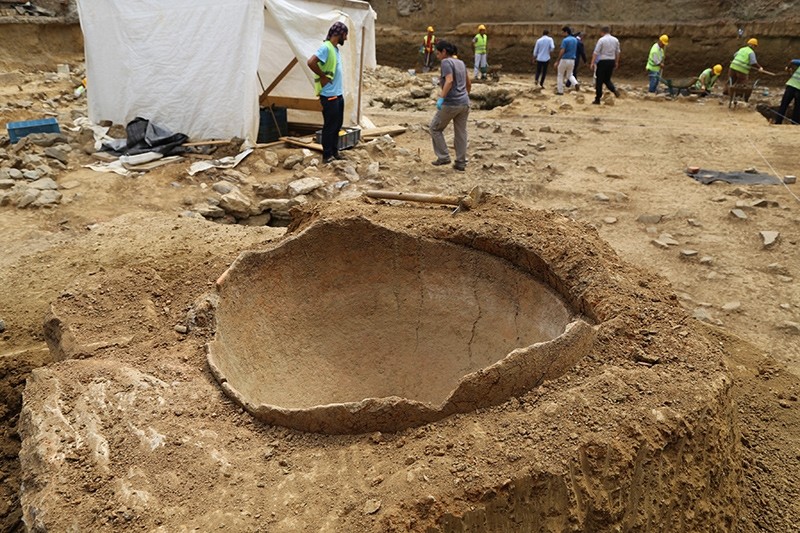
Archaeologists made an intriguing discovery recently at the neolithic site of Göbekli Tepe in southern Turkey. They uncovered a series of giant stone troughs erected more than 10,000 years ago. And at the bottom of these huge vessels, they found traces of a chemical called calcium oxalate, typically produced during the soaking, mashing and fermenting of grain. It’s a by-product of brewing, in other words.

From this evidence, researchers conclude that Göbekli Tepe was a vast festival site where Stone Age men and women came to feast and to drink beer by the trough-load. Humans have known how to party for a very long time, it would seem. In fact, our love of alcohol can be traced even further into the past, according to scientists who now believe that social drinking played a key role in our evolution as we developed into big-brained, social primates.

It is a theory that will form the core of a major conference at the British Academy next week, Alcohol and Humans: A Long and Social Affair. Delegates will argue that our love of alcohol is deep-rooted and that drink – although harmful in excess – still has a role to play in generating happiness and wellbeing, as the broadcaster Adrian Chiles maintained in his TV film, Drinkers Like Me, last week.

“Studies clearly show that there are social and wellbeing benefits to be derived directly from drinking alcohol, especially in relaxed social environments,” said the evolutionary biologist Professor Robin Dunbar of Oxford University. “That is why the practice has persisted for so long.”

Dunbar, a fellow of the British Academy and one of the conference’s organisers, argues that our hunter-gatherer ancestors began to hold feasts at least 400,000 years ago after they learned how to use and control fire. Dinners round firesides helped us to cement relationships as fellow tribesfolk exchanged food, stories and gossip. Alcohol may not have been present at first but could still have become a key factor of feasts fairly quickly, and certainly long before the Neolithic arrived and we began to make brewing troughs.

“Archaic humans may have been very familiar with naturally fermented fruits and may well have consumed them avidly – much as chimpanzees and elephants do in Africa,” said Dunbar.

The crucial point is that all these activities – relating stories, exchanging gossip, telling jokes and singing – trigger the production of endorphins in the brain, he said. “Endorphins in turn generate a positive feeling in a person, similar to that of morphine. So we feel good. And crucially, alcohol also activates the endorphin system, which in itself will enhance social bonds among those who indulge together.”

In other words, alcohol was vital in helping to strengthen social bonding and break down inhibitions – and has done so since the early days of human evolution. Certainly, we had long mastered the art of making the stuff before we made those first stone troughs and pottery vessels 10,000 years ago. It continued to have a considerable influence on our history, however. Take the example of farming. It was once assumed we turned to agriculture and the growing of fields of wheat in order to make bread and so provide reliable sustenance for ourselves. Yet the kind of wheat grown then – known as einkorn – would have made a very poor bread, say researchers. But it would have made excellent beer.

“This leads to the great theory of human history: that we didn’t start farming because we wanted food – there was loads of food around,” says Mark Forsyth, in his book A Short History of Drunkenness. “We started farming because we wanted to booze.”

This idea is backed by others, including Dunbar, who believe beer-making was the initial attraction in turning ourselves from hunter-gatherers into farmers. And, ever since, alcohol has made its mark on our lives, from lubricating parties to complex state rituals.

“By the 17th century, after the [English] civil war, drinking had become a critically important social act,” said the historian Angela McShane, of the Wellcome Trust, who will also speak at the conference. “It was a way of demonstrating your loyalty to the state in terms of the toasts that you were expected to make. If you got them wrong, you could be killed.

“To not drink not only suggested that you were not much fun to be with but that you were dangerous or seditious, because you would not toast your allegiance. That attitude became so embedded in our culture that, even today, there is a feeling among some people that they don’t quite trust someone who does not drink.”

In our own day, excess alcoholic intake has been linked to a host of health problems, from increased risks of contracting liver disease and cancers to suffering serious accidents. As a result of medical campaigns, average intakes have declined from an annual high of 9.5 litres of alcohol per head in 2004 to 7.8 litres in 2015.

But McShane pointed out that there was no set medical opinion about whether or not alcohol was good for you. “Some doctors will say that whatever amount you drink, it will have an adverse impact on your body. But that is true of tea, coffee or even water. What we should also realise is that alcohol is a lubricant that can smooth the running of society.”

Dunbar agrees. He pointed to one analysis of 148 epidemiological studies of heart attack patients, which was then used to isolate what factors best predicted a patient’s survival 12 months after a heart attack. “The most important turned out to be the quality of their relationships with others,” he said. “Giving up smoking, obesity and exercise were less important than the number of good friends you had. In other words, our social networks play a central role in our ability to survive the worst traumas that life can throw at us. And those networks are very clearly enhanced by the use of alcohol.”

Other studies conducted by Dunbar show that those who regularly visit their local pub for moderate drinking tend to be more socially engaged, feel more contented and are more likely to trust other members of their community than those who do not drink at all.

“Most research that is carried out on alcohol and humans has concentrated on its excessive use – its abuse – by men and women,” said Dunbar. “Moderate social drinking has been ignored as subject of study until relatively recently. These latest studies suggest that the impact of moderate alcoholic intake is surprisingly beneficial.”

Archaeologists uncovered a series of giant stone troughs erected more than 10,000 years ago at Göbekli Tepe,

Thursday, October 12, 2017

LibraryStudies | Ancient Texts / Books Other | Latest posts
Author: Tafel,  Franc Babinger | Language: French
Ethnographic des Vilayets d'Andrinople, de Monastir, et de Salonique, 1878

Ethnographic des Vilayets d'Andrinople, de Monastir, et de Salonique, by Franc Babinger. 1878

Wednesday, September 20, 2017

Excavations conducted in the ancient city of Patara in Antalya province have revealed more than 200 objects, including a bronze mirror frame, forks, bowls and coins, giving hints about the daily practices of the civilization that lived in the ancient city.
More than 200 utensils that are 2,350 years old, including a bronze mirror frame and a fork, have been unearthed in the ancient city of Patara, located in the Kaş district of Antalya province.

The excavation works in Patara started in 1988 and are being continued by the head of Akdeniz University's Archaeology Department Prof. Havva Işık and her team. Speaking to Anadolu Agency, Işık said Patara is one of the most important ancient cities of the Mediterranean region.

Implying that Patara was the prophecy center of Apollo, the god of art, music, sun, poem and fire in mythological sources, Işık said Saint Nicholas, who is an important figure in the Christian world, was also born there, and he created his teachings in Myra.

She added that they have focused on the area around the Nero Hamam this year, and the excavation works in the basilica and Tepecik Acropolis in the heart of the city are ongoing.
"Tepecik Acropolis, which is the most important area of the excavations, houses the earliest settlement. This is why the most important findings have been found there," Işık said.

She indicated that they are trying to reveal the Hellenistic and classical period with the findings there.

Noting that they discovered many interesting artifacts in the excavations of the Tepecik acropolis, Işık said more than 200 works have been found in a construction site that was demolished because of an earthquake or fire.

The goods, which have been found together in the same area including meal bowls, weights, sculptures and coins, are in good shape.

"This house is a think tank for us. These works are important since they provide information about the Hellenistic period. They bring important information about daily life," Işık indicated.
Noting that the earthenware baby bottle, bronze mirror frame and iron fork were important findings, vice head of the Patara excavations associate professor Şevket Aktaş said, "We think these findings belong to an important figure. We have found more than 200 household goods together. They date back to 2,350 years ago. We date them at the end of the Hellenistic period and the beginning of the Classical period. We generally discover broken pieces in excavations. However, it was so exciting that we have found them simultaneously and in preserved shape."

loading...

Explaining that the baby bottle was used for fluids like milk, Aktaş implied the importance of these findings to understand the family structure of the period.

Starting from the bronze mirror frame, he also commented that these goods possibly belong to someone rich because ordinary people from this period didn't use mirrors.

In order to show the importance of the findings to get information about the daily life of the period, Aktaş gave the example of weaving looms. Many weaving looms dating back to 350 B.C. have also been found in the excavations but their wooden parts were unable to last over the years.

Additionally, in Patara, the parliament building of the Lycian League, which is accepted as the first democratic parliament of the world, was opened to tourism after reparation by the Grand National Assembly of Turkey in 2011.

2,350-year-old goods unearthed in Patara reveal ancient way of life

Saturday, September 16, 2017

Parium (or Parion; Greek: Πάριον) was a Greek city of Adrasteia in Mysia on the Hellespont. Its bishopric was a suffragan of Cyzicus, the metropolitan see of the Roman province of Hellespontus

Founded in 709 B.C., the ancient city of Parion is located in the village of Kemer in the township of Biga in Çanakkale province of Turkey, currently. A major coastal city with two harbors in the Roman period, Parion had intensive relations with Thrace and Anatolia throughout history. This was the main customs station through which all Istanbul-bound goods from Greece and the Aegean had to pass.

The skeletons of a total of 24 people, including one child, have been unearthed from a chamber tomb opened during this year’s excavations in the ancient city of Parion in the northwestern province of Çanakkale. 

The mystery of this multi-burial tomb, which has surprised archaeologists and is estimated to date back to a period between the 1st and 3rd centuries, will be solved by anthropologic researches to be carried out next year. 

This year’s excavations have recently ended after they were initiated on July 3 in the 2,600-year-old ancient city of Parion, located in the Biga district’s Kemer village. 

Headed by Ondokuz Mayıs University Archaeology Department Professor Vedat Keleş, the excavations unearthed new findings this year. Among them, the most interesting one was the skeletons found in a chamber grave. The tomb was unearthed in 2011 during illegal excavations and the last tomb was opened this year.

“A chamber tomb was uncovered here in 2011. We started excavations in the same year and found six 2,600-year-old chamber tombs. Their architectures are similar to each other. But particularly the one that we opened this year and named OM-5 is very interesting in terms of its burial method. Even though the other five have the same architectural features, their burial methods are different. We found the skeletons of 23 adults and a child inside this one,” Keleş said. 

He noted that they believe the people were buried at a time between the 1st and 3rd centuries. “It shows us that there was a significant demographic increase in Parion during those years. The skulls of 15 skeletons were found on one side of the tomb. Seven were buried in the northeast direction. We also found the skeleton of a child. The existence of six chamber tombs next to each other shows that people with special statuses were buried in this field,” he added. 

The professor said they also found some objects inside the tombs, which were put as gifts for the dead.

“We found ancient items, including three tear bottles, one of which is a glass, a plate, an amphora and a pitcher. We also found a strigil, used by ancient people to clean their bodies,” he added. 

Keleş said they closed the chamber tombs to prevent damages on them, adding that the skeletons will be removed next year.

Skeletons found in tomb of the ancient Greek city Parion in Turkey


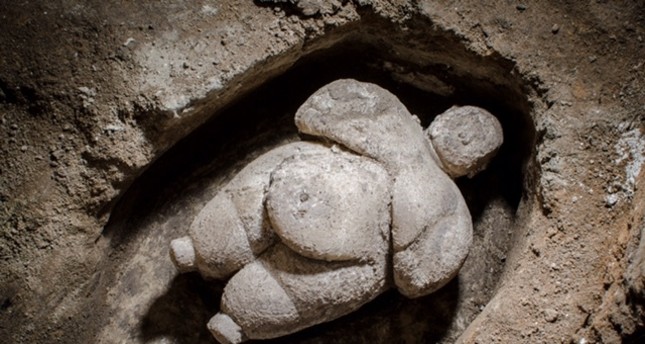
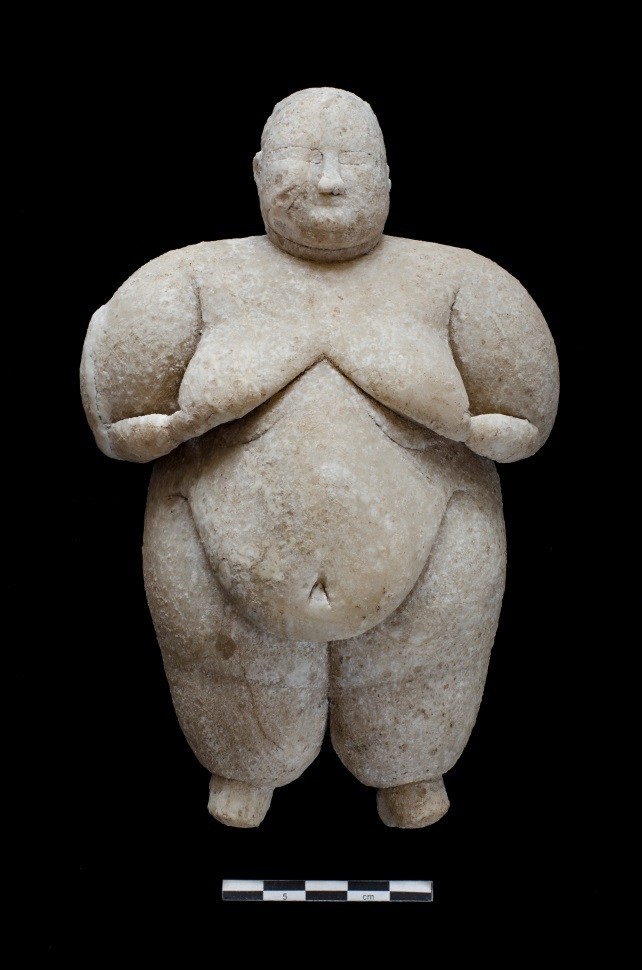
Archaeologists at Turkey's neolithic site of Çatalhöyük in central Anatolia have unearthed a "unique" complete female figurine, The Ministry of Culture and Tourism said on Tuesday.


The statuette, measuring 17 centimeters (6.7 inches) long and weighing one kilogram (2.2 pounds), is considered unique due to its intact form and fine craftsmanship; it dates back to about 5500-8000 BC, a statement said.

The figurine, which is made of marmoreal stone and considered to be part of a ritual, was discovered by the international team of archaeologists working on site led by Professor Ian Hodder, anthropologist at Stanford University in the U.S.
One of the world's first urban centers which dates back 9,000 years, Çatalhöyük is included in the 2012 UNESCO World Heritage List.
"Çatalhöyük has been the subject of investigation for more than 50 years. Researchers from around the world have travelled to the site over the past half-century to study its vast landscape of buildings, remarkable ways of life, and its many exquisite works of art and craft.

"Since 1993, the Catalhoyuk Research Project has recruited an international group of specialists to pioneer new archaeological, conservation and curatorial methods on and off site. Simultaneously, it aims to advance our understandings of human life in the past," according to the official website.


loading...

Neolithic figurine, over 7,000 years old, unearthed at Turkey’s Çatalhöyük

Friday, September 15, 2017

An Ancient Greek 2,000-year-old ancient baby bottle was discovered Tuesday in the Biga district of western Turkey's Çanakkale province.


The discovery was made during excavation works in areas of the Hellenistic period antique port city of Parion.

Member of the Parion Antique City excavation team and Assistant Professor of Archeology Department at Atatürk University, Hasan Kasaoğlu, said the baby bottle had a single handle and a pacifier-like spout.

       HOT ON THE WEB
http://thrgo.pro/?rid=-6AAAAAAAE6RUBAAAAAAAAAAQaFiaiAAAA"These bottles were used during ancient Roman times 2,000 years ago as equipment to feed babies milk or food. These are earthenware produced as a result of firing," Kasaoğlu said, adding that such bottles could be found in areas dating back to early Roman period.

According to the archeologist, such bottles could sometimes be discovered in baby tombs in areas dating back to early Roman period. He said they were left in tombs as burial gifts, adding that the bottles were equipment used in daily life.

loading...

Kasaoğlu also said that the ancient baby bottles usually had a volume of 50-100 milliliters.

"The products were made so that a baby could drink any liquid or baby food from it. They are all made from baked clay. The clay is molded by pressing, then fired and ready for use," Kasaoğlu added.

2,000-year-old ancient Greek baby bottle unearthed in Turkey’s Çanakkale

Thursday, September 14, 2017

Conservation, restoration and integration works have been initiated for the Hellenistic towers in the ancient city of Perge in the southern province of Antalya. The work has been carried out by the Antalya Directorate of Surveying and Monuments.

Antalya Surveying and Monuments Director Cemil Karabayram said the ancient city dates back to the second and third B.C. and that the Hellenistic towers needed to be restored.

He said the tender had been finished for the restoration of the towers and the ancient structure was one of the most magnificent structures in the Pamphylia era.

Karabayram said the towers were not built to show off but for defense.

He also said the restoration project had a budget of 2.5 million Turkish Liras and the work in the towers was actually initiated in the beginning of the 2000s.

“Nearly 2,000 stones in the tower were classified. Now the proper stones will be used again in the restoration,” he said.

Karabayram said their restoration will be complete in mid-2019 and the towers will open for tourism.

He said the towers were taken under protection in 2007 with the steel construction method in order to prevent the stones from falling or a possible collapse.


“After the restoration, the steel frames will be removed from the towers. The stones were examined one by one and the project was approved by the relevant preservation board. At the moment, it is evident where most of the stones will go. When the work is complete, we will be able to open 70-80 percent of the Hellenistic towers for tourism. The project will be carried out under the consultancy of academics and scientists,” said Karabayram.

Theater section to open

Karabayram noted there is also other restoration work in the ancient city of Perge.

“We are planning to open the theater section for use. Work has also started on the stadium with the support of the Culture and Tourism Ministry. In addition, we have a street going through the center of the ancient city. It will also go out to tender. Perge is undergoing serious restoration and improvement,” he said.

Professor Jale İnan, Professor Haluk Abbasoğlu and the head of excavations, the Antalya Museum Director Mustafa Demirel, have had an impact on the work in Perge, said Karabayram. He also said the restorations in the area will not be a complete restoration, but will only be made using the available materials.

Ancient Hellenistic towers in Antalya being restored

Ruins of a church dating back 800 years have been unearthed at the ancient city of Adramytteion in the northwestern Turkish province of Balıkesir’s Burhaniye district.

The find comes just two weeks before the end of this year’s seasonal works.

loading...

Murat Özgen, the director of the Mimar Sinan Fine Arts University Northern Aegean Research and Application Center, said excavations at Adramytteion have been continuing since 2012.

“This year excavations have continued in a field on the Ören Hill, which we call ‘Region C.’ A big church was found during excavations between 2000 and 2006, dating back to the 11th century. During the works two years ago we found the apse of the church. We already knew there was destruction in the 11th century.
The latest church we have found confirms this knowledge as it was destroyed. Now we have two weeks to finish the works here. Our reconstruction plan for protection has also been approved,” Özgen said.

11th century church ruins found in Balıkesir

Sunday, September 10, 2017

The Turkish Culture and Tourism Ministry announced Sunday that the sarcophagus of Heracles has been handed over to Turkish officials by Swiss authorities in Geneva and will be returned to its homeland in Turkey Wednesday.

The tomb of Heracles, which dates back to the Roman period in the second century B.C. and depicts the Twelve Labors of Hercules, was confiscated in 2010 by the Switzerland customs authority at the port of Geneva.


The tomb was delivered to the customs area on September 6 and will soon be moved to Zurich to be returned to Turkey on a September 13 cargo flight after an official deal is signed by both Turkish and Swiss authorities.

Turkish ministry officials said safety measures were put in place to ensure the tomb's safe arrival to Turkey.

loading...

Th tomb, discovered during illegal excavations in the 1960s in the Aksu district of Antalya at the necropolis of Perge, will be exhibited at the Antalya Museum Directorate.

With the consensus of both countries, the tomb was exhibited at Geneva University for three months before being returned.

With a height of approximately 135 centimeters (53 inches) and width of 112 centimeters, the 3,000-kilogram (6,600-pound) tomb has been dubbed "Torre Nove" in archaeological literature.

Ancient ‘Sarcophagus of Heracles’ ready to be returned to Turkey

Friday, September 8, 2017

Clay tablets dating back 4,000 years show the beginning of writing and literacy in ancient Anatolia, in the middle of modern-day Turkey, according to researchers.

Excavations in the province of Kayseri, southeast of Turkey's capital Ankara, at an ancient settlement or burial mound shed light on writing from around the year 2000 B.C., said Fikri Kulakoğlu, a professor of archeology at Ankara University and head of the excavation team.

In 70 years of excavations at the Kültepe settlement, 25 kilometers (15.5 miles) northeast of Kayseri, some 23,000 cuneiform-script tablets have been found.

"These are the first written tablets in Anatolia. Anatolian people learned how to read and write in Kültepe. The first-ever literate people in Anatolia are from Kayseri," said Kulakoğlu.

Many of the tablets excavated are exercise tablets, apparently used by children to practice their writing.

The reading exercises in scripted tablets are signs of school-like instruction, he said.
loading...

4000-year-old clay tablets discovered in central Turkey

Wednesday, September 6, 2017

An ancient Greek 2,500-year-old mausoleum in the southern province of Antalya part of Ancient Greece has become the victim of vandalism.

Considered one of the symbolic mausoleums of the Lycian era, the mausoleum, located in the Gölova neighborhood, 12 kilometers away from the Elmalı district, had classical-age paintings and Byzantine-era decorations. However, the inside and outside walls of the structure have been scraped off and painted with colored paints.

“A 2,500 year old mausoleum is the victim of graffiti. It is disappearing in front of us,” said Ertuğrul Gün, a local, who reacted against the situation.

“We are sad about this vandalism against historical values. We have sent photos to various directorates to clean the structure and protect it. I hope it will be protected before it sees more damage,” said Gölova Mayor Ali Küçük.

“I was very sorry when I saw the structure. It was completely destroyed. We have ordered for the writing to be cleaned using a nutshell. We do not use the sanding method because it may cause scratches,” said Antalya Relievos and Monuments Director Cemil Karabayram.

loading...

The ancient Greek structure, dating back to the fifth and sixth century B.C., was examined by U.S. Professor Machteld J. Mellink. The structure had previously been damaged by treasure hunters.

Ancient Greek Lycian-era mausoleum destroyed in Turkey’s Antalya

Sunday, September 3, 2017

Excavation teams, using information from famed Ottoman explorer Evliya Çelebi's travel guide, are continuing work along one of Anatolia's longest underground water passageways in northeastern Turkey, unearthing the lost history of a millennium old Turkish neighborhood in the process.

Atatürk University-sponsored archaeological digs have been ongoing in the Mengücekliler district of northeastern Turkey's Erzincan for the past six years, especially around Kemah Castle, an area where early Turks migrated from Central Asia.

With assistance from the Turkish Ministry of Culture and Tourism, significant historical monuments and remains have been unearthed throughout the excavations.

Among Anatolia's longest historical water tunnels, which stretch for about 350 meters between the Kemah castle and the Tanasur stream, a 1,000-year-old Turkish neighborhood has been one of the teams' major discoveries.
Dr. Hüseyin Yurttaş, head of Atatürk University's Art History department, told Anadolu Agency that a book entitled "Seyahatname" (Book of Travel) by Evliya Çelebi has been a guide to the excavation work.

Yurttaş said that according to Çelebi's book, there were 600 homes in the castle, as well as 11 houses of worship and 3 minarets.

"We have slightly departed from what Evliya Çelebi told us, and have started guiding that path ourselves. We discovered an approximately 1,000-year-old Turkish neighborhood through the excavations in Kemah."

The excavations have revealed that there were water tunnels in the upper Euphrates region, beginning from the Kemah Castle at a height of 1,053 meters above the sea level and moving to the Tanasur stream, down to a level of 50-60 meters, which indicates the water needs of past residents.

                      HOT ON THE WEB
http://thrgo.pro/?rid=-6AAAAAAAE6RUBAAAAAAAAAAQaFiaiAAAA
Emphasizing that one of the most important historical features of Kemah Castle were these tunnels, Yurttaş continued, "These water passageways were built with vaults in place."


"The tunnels are the longest in Anatolia, and according to our measurements, the tunnels stretch to around 350 meters still today. Because they are in ruins, it is difficult to reach them, but they are most visible from Kemah Castle," he said.

An assistant in the excavation team, Muhammet Lütfü Kındığılı, also said that they had discovered the structure of a kiln, which alluded to the production of ceramic pieces belonging to the Byzantine period from the 12th and 13th centuries.

Evliya Çelebi was an Ottoman traveler, who voyaged through Ottoman territory and neighboring lands over a period of forty years in the 17th century. He recorded his commentary in a ten-volume travelogue called the "Seyahatname."

Born in Constantinople in 1611, Evliya was a devout Muslim opposed to fanaticism, who could recite the Quran from memory. He was employed as an entertainer to the Ottoman court, but eventually refused employment that would keep him from travelling.
loading...

Using Evliya Çelebi's travelogue, excavation team discovers 1,000-year-old Turkish neighborhood

Tuesday, August 29, 2017

Water coming out of a hidden tunnel has caused difficulty in the progress of the restoration work on Tokat Castle, also known as the “dungeon of Dracula.”

The hidden tunnel, named “Ceylan Yolu,” was discovered during the restoration work, which started in 2009, on Tokat Castle in the northern Anatolian province of Tokat.

The tunnel is claimed to be the place where Wallachian Prince Vlad III “The Impaler,” also known as Dracula, who lived between 1431 and 1476, was held captive.

The provincial Culture and Tourism Director Adem Çakır said Tokat Castle was built in the city center in the Byzantine era and served as a prison for 300 years.

“Ceylan Yolu is a tunnel with stairways. There are similar tunnels in most castles like this. We cannot decide if this place is a hidden tunnel or not because there are [housing] developments on the skirts of the castle. There is a serious rise in the ground level because the waters of Behzat Lake and Yeşilırmak River are rising,” said Çakır.

Çakır said they have reached 150 meters in excavations in Ceylan Yolu.

“We think we have reached the foundation of the houses on the skirts of the castle. The biggest problem is that there is water in the tunnel. It is a big problem to remove both earth and water. It is not possible to draw water out with a water engine. The work has serious costs. We may stop excavations at the end of the season because we cannot continue the other work on the castle before finishing the excavations in the tunnel,” he said.

He also added that a film will be shot in the castle in September.

Water handicaps restoration work on ‘Dracula’ castle

Monday, August 28, 2017

An underwater ancient city in Turkey may be opened up to holiday-makers for the first time in 30 years as the Turkish government aims to boost tourism to the country.

The sunken ruins of ancient Simena, which was destroyed by earthquakes during the second century, lie just off the coast the small uninhabited island of Kekova.
Kekova is a small rocky island in the Mediterranean Sea just off the mainland’s Antalya Province — the centre of Turkey’s tourism industry. Kekova also draws great attention from tourists for its clear water and sea creatures and is one of the leading spots for boat tours.

But since 1986, the island’s most curious attraction has been all but closed off for exploration. While it is possible boat or kayak around the area, and dive nearby, underwater exploration has been banned since 1986 as part of a series of measures to protect the lost city’s heritage.

Turkey declared the region a Specially Protected Area in 1990, and in 2000 submitted Kekova to UNESCO for consideration as a World Heritage Site. It currently sits on the organisation’s Tentative List.
UNESCO describes Kekova as “a rarely seen attraction” but a “remarkable example of cultural continuity, and a living cultural assents”.
But now the Antalya Mayor wants to overturn the ban and open it up to a growing diving tourism market.
Applications have been made to the Culture and Tourism Ministry and the Ministry of Environment and Urbanization for a partial removal of the ban to allow restricted diving under the guide of archaeologists, so as not to damage the sunken ancient city.
“Not only Kekova, but all the coasts of Antalya are rich in terms of archeology. Our efforts to diversify tourism alternatives have begun to bring results and interest in diving tourism has increased,” Mayor Münir Karaloğlu told Turkish news publication, Hurriyet Daily News.

“If permission is received from the ministries, diving tourism will be available with the help of guides and archaeologists in Kekova.”
The ancient underwater city is home to rich historical heritage, including inscriptions with the Lycian alphabet, tombs, the ruins of breakwaters and structures, a rock-carved theatre from the Middle Age, water cisterns, a necropolis of rock tombs and an ancient harbour.

And considering much of the sunken ruins are still high enough that they can be seen from the surface, diving tours won’t be restricted to experienced divers.
Levent Işık of the Kekova Diving Centre says a lift on diving restrictions could transform the island.
“The potential for tourists to dive this site is of great interest to all who wish to find out more about our heritage”.
“Once this ban has been lifted it will have a tremendous impact as many underwater archaeologists and universities will want to come and see more of the secrets that the 4000 year old civilisation had.”

Sunken ruins of ancient city in Turkey may soon be opened up to explore

Wednesday, August 23, 2017

A local religious conservative foundation staged a protest in the Black Sea province of Sinop on Aug. 22, demanding the removal of a statue of Ancient Greek philosopher Diogenes.

The Erbakan Foundation said it was protesting the fact that the Greek ideology being attached to the province rather than arts.

“We are not against arts and sculptures. We are against the fact that they are attaching Greek ideology to Sinop under the cover of the statue. We want the Diogenes statue to be taken from the entrance of Sinop and moved to Balatlar [a local Byzantine church]. We will put in effort for this. We will struggle to the end, whether a petition or a permanent press statement here is required,” said İsmail Teziç, the foundation’s Sinop provincial representative.

Born in Sinope, modern-day Sinop, an Ionian colony on the Black Sea, in 412 or 404 BC, Diogenes is known as one of the founders of Cynic philosophy. He was also noted for having publicly mocked Alexander the Great.

After being captured by pirates and sold into slavery, Diogenes eventually settled in Corinth, Greece, where he died in 323 BC.

Conservative group demands removal of statue of Ancient Greek philosopher in Turkey’s Sinop

Construction workers in Istanbul's Beşiktaş district digging the ground for a new metro project connecting Istanbul's Kabataş-Beşiktaş-Mecidiyeköy-Mahmutbey districts have discovered human bones and cremated remains from the eighth and 12th centuries B.C.

According to a report by the Habertürk Daily, teams from the Istanbul Archaeology Museum have been conducting excavations over the past year.

Led by museum director Zeynep Kızıltan and with the participation of archaeologists and 45 workers, the excavation revealed details of cremation practices during the Iron Age.

Accordingly, the ancient people preserved the cremated human remains in terracotta urns and buried them.

Kızıltan noted that the team has discovered three human skeletons at the site, which have been buried according to practices used by the people who migrated from the Black Sea region.
She explained that many people were forced to migrate from the northern Black Sea region, around Crimea as a result of climate and war, seeking refuge in Anatolia.

"We don't know which background the people who lived around the Black Sea came from" Kızıltan said, adding that some of those who fled the area came to Istanbul through Thrace.

The findings shed light on 3,000 to 3,500 years of human history, Kızıltan noted and added that DNA tests will be carried out to find out more about the ethnicity of the people, and to properly identify the gender and age, as well as the diet of the people who lived during the Iron Age.

The Iron Age around the Near East is believed to have begun with the discovery of iron smelting techniques around Anatolia in the second century BC.

Infrastructure work in Istanbul, and in various places throughout Turkey, require archaeological excavations before breaking ground, as the country was home to numerous civilizations.

Discovery of ancient human remains in Istanbul metro construction site

Works have been initiated this summer to unearth a stadium in the ancient city of Laodicea, a property on UNESCO’s tentative list for World Heritage Sites. The stadium was a venue for sports competitions and gladiator fights in ancient times and is located in the western province of Denizli.

Excavations and restorations have been ongoing in the ancient city for 13 years under the leadership of Professor Celal Şimşek of the Pamukkale University (PAU) Archaeology Department. Some 4,000 artifacts have been uncovered so far.

The artifacts include figures, sculptures, agricultural tools, and household products and have been under protection. The Holy Agora, which is home to one of the seven holy churches mentioned in the Bible but which collapsed in an earthquake along with its columns in 494 A.D., has been restored and revived.

A project has also been initiated to unearth the Laodicea Stadium, located on Stadium Street in the ancient city and known as the largest stadium in Anatolia in the era.

The project has been approved by the Cultural and Natural Heritage Preservation Board and gets supported by the Merkezefendi Municipality. When it is finished, the stadium will be revived after 1,494 years.

Speaking to Anadolu Agency, Professor Şimşek said this year’s excavation and restoration works have still been continuing in the ancient city, focusing on the project made for the revival of Stadium Street.

“The recovery of the ruined columns continues. They will be revived with their arches within three months. The street will regain life after 1,500 years,” Şimşek said, adding that the street where the excavations are continuing is very important.

He said the Laodecia Stadium was the biggest one in Anatolia.

“It is a gigantic structure that is 285-meters high and 70-meters wide. Right next to it is a bath complex. It is one of the biggest bathes in Anatolia. There is an agora and an assembly building next to it. This place was a field of both sports and administration and people came together. From this aspect, the street has importance too,” said Şimşek.

Arena of gladiators

Şimşek said many competitions were held in the Laodicea Stadium in ancient times and the names of five-time winners of the competitions were written on inscriptions.

“At the same time, this stadium is very important for gladiator fights. The competition was held not only for this city but also the other cities in the Lycus lowlands. All Olympic-size games, local or big sports competitions, and gladiator fights have been held in this stadium,” he said.

Ancient stadium under restoration in Denizli , Turkey


From the Neolithic caves riddling its cliffs to the honey-colored, 15th-century minarets looming over its streets, Hasankeyf, Turkey, is a living museum of epic proportion.

Rare birds soar around the crumbling towers of its Artuqid bridge. Shepherds' songs have echoed through its canyons for centuries, even as the area transformed from a Byzantine bishopric to an Arab fortress to an outpost in the Ottoman Empire. Almost every major Mesopotamian civilization has occupied this 12,000-year-old settlement site on the banks of the Tigris River in southeastern Turkey, not far from the border with Syria.
But the Tigris River gave rise to the world's first settlements and soon its waters will submerge some of their remnants as plans move forward to construct a hydroelectric dam that will flood a large tract of Mesopotamia in southeastern Turkey.

Through a project decades in the making, Turkish officials say the 1,200-megawatt Ilisu Dam will provide much need electricity and irrigation to the region, yet opponents have decried the loss of ancient sites, such as Hasankeyf, upon the dam's completion.

With traces of human civilization dating back to 10,000 B.C., Hasankeyf is one of oldest continuously inhabited settlements in the world, baring the imprints of more than 20 civilizations. Located on the banks of the Tigris, its steep, limestone cliffs house clusters of Neolithic-era caves topped with a Roman fortress amid Artuqid and Ottoman landmarks.

As German spat deepens, Turkey draws tourists from elsewhere
Until recently, this visual stratification of history continued to draw tourists, but the site has been closed off for more than a year and, last week, crews began dynamiting cliffs near Hasankeyf to prepare the area for flooding as dam construction nears its final phase.


One final protest
While condemnation from local and international communities has long stalled the project, the efforts ultimately failed to halt dam construction. Upon seeing the dynamite crews at work, Mehmet Ali Aslan, an MP for the city of Batman for the Peoples' Democratic Party (HDP), single-handedly began a protest to stop the demolition.
"When I first watched those videos, I couldn't believe it," Aslan told. "I thought of IS bombing Palmyra or the Taliban bombing Buddhist statues. When historical sites are attacked like this, I believe it's a terrorist act."
In what he claims was a spontaneous act, Aslan chained himself to a rock in the Hasankeyf Valley and forced crews to temporarily stop demolition work.

State-run media reported the dynamiting was needed to clear potentially hazardous rocks. Aslan rejected the claim, saying that filling valleys with debris from historical sites was not only cruel, but served as a cheap way for construction companies to manage the water reservoir which will soon inundate the area.

Aslan has since ended his protest, but said he would return with more people if dynamite crews resumed their activities.

In response to criticism, state officials have said the future reservoir will spur new opportunities for tourism in the area, including scuba diving excursions to submerged monuments. Officials with Turkey's Ministry of Forestry and Water Affairs and Ministry of Culture and Tourism did not respond to interview requests before the publication of this article.

Short-term motivations, long-term damage
Ridvan Ayhan, a member of the Save Hasankeyf Initiative who witnessed the dynamite crews in action, said he was most frustrated by shortsighted planning of the project. Upon completion, the Ilisu Dam is expected to be operational for 50-70 years before being decommissioned.
In Ayhan's view, the short-term gains in energy production do not justify the destruction of a 12,000-year-old settlement.
"People that don't have a past cannot determine their future," Ayhan told. "They are not only destroying our past, but also our future by taking away this as a source of income and heritage."
"We would like to apologize to the future generations for allowing this," he added.

When the area is flooded, a total of 199 settlements will be submerged and 15,000 people will be relocated to the recently built city of "New Hasankeyf" on higher ground. Ayhan said he believes the undertaking is a political decision to displace villagers suspected of aiding Kurdish guerillas in the region.

The creation of a reservoir would not only inhibit the local movement of militants with the Kurdistan Workers' Party (PKK), a terrorist organization outlawed by the Turkish government, but would also deny them access to critical provisions and intelligence from a network of rural villages.

Unrecognized by UNESCO
Throughout the Hasankeyf debate, the international community's main advocate for the preservation of world heritage, UNESCO, has remained largely silent. This is because state governments must submit individual historical areas to UNESCO for them to be included on the organization's list of world heritage sites.

As plans for the Ilisu Dam have been on drawing boards since the 1950s, the Turkish government never formally requested such recognition for Hasankeyf.

"UNESCO is not mandated to pass judgment on the internal affairs of its member states," wrote Roni Amelan, a UNESCO press officer, in an email. "Since the site [is not] on the World Heritage List, we must regard its management as an internal issue."

Critics have lamented the inaction of UNESCO officials, saying their refusal to speak on Hasankeyf undermines the organization's credibility. Ali, a Kurdish archeologist who gave an alias out of fear of losing his job, has also faulted local populations for allowing dam construction to proceed.

"There was a strong protest movement until five to 10 years ago," Ali told . "Now people are more preoccupied with the war in Syria and Turkey's political situation, so questions of our historical heritage get less attention."

Though one significant tomb was moved for preservation purposes, Ali said much of the Turkey's population does not see the value in historical monuments.

"They don't have the vision to use them in a more economically effective way," Ali said. "We could have sites like Machu Picchu or the pyramids in Egypt. We could have our own tourist attractions, but [the government] doesn't care about heritage east of Ankara."

Tomb of fallen warrior to move before dam floods ancient Turkish township

Saturday, August 19, 2017

Pieces that have fallen from ornaments carved on big stones 2,700 years ago in the Ayanis Castle, built by the Urartian King Rusa II on a hill overlooking the Lake Van, are being attached to their original places with special materials. 

The places of the pieces have been determined by restorers and sculptors after a two-year work.

An important and special Urartian temple with its stone and adobe workmanship as well as the adornments on its walls, Ayanis Castle has been undergoing excavation works headed by Erzurum Atatürk University’s archaeology department’s Professor Mehmet Işıklı. A team of 25 people from Erzurum Atatürk, Dokuz Eylül, Van Yüzüncü Yıl, Batman, Eskişehir, Anadolu and Ordu universities are working in the field.

New structures and artifacts unearthed during excavations carried out in the castle in the past 28 years give important clues about life 2,700 years ago. 

Işıklı said this year they focused on preservation and restoration works in the castle and around, and that the Haldi Temple and sella structure that were unearthed in the castle 20 years ago are the most special parts of the Urartian castles. 

Stating that the detailed restoration works on ornamentations and decorated stones in the temple field were continuing, Işıklı noted that it was a very troublesome and demanding work. 

“Our experts have been busy with finding the places of pieces falling from the big ornamented stones for two seasons. Once they find the original place, they attach the pieces with restoration materials,” he said. 

Işıklı said finding the places of the pieces one by one was a very difficult task.

“Now we attach these small pieces to their places. The same work will be carried out in the other parts, but at first we have to complete the missing parts with drawings. It is very hard to restore the whole temple like this. We will finish one field this year with our own efforts. Then with the support of some institutions, we will finish the restoration inside and open the temple to visitors. The temple will have a healthier environment,” he added. 

He said 28 years have passed since the start of the excavations, in which they obtained important information about the temple.

“A roof was made for better preservation. When the roof is completed, we accelerated the restoration works. When the project is finished, people will be able to visit the temple and the walls. We also have the second stage of the project, approved by the Cultural and Natural Heritage Conservation Board. We will construct a partial walking route. We will propose to the ministry to make the Ayanis Castle an archaeological site,” he added.

source

Ancient ornamentations being restored in Van

Friday, August 18, 2017

The remains of two tile furnaces have been found in archaeological excavations in İznik, known as a historic center of tile production in the northwestern Turkish province of Bursa. 

Officials have initiated work to unearth the furnaces, which date back to the 14th and 17th centuries. 

Current excavations at the site, which started in July and will continue until September, are being carried out by a 15-person team of students and experts, headed by Istanbul University History of Department academic Belgin Demirsar Arlı. 

Arlı said they are trying to illuminate historic tile and ceramic methods in their works, adding that the tile furnace excavations are ongoing in a field located in east of the Murad II Bath in İznik. 

“We started work at a new field in the north of the excavation field and we found two new furnaces. They are important in terms of the art of İznik tile-making, so the furnaces will be taken under protection,” she stated.

The İznik tile furnaces were discovered in 1967 by Istanbul University Head of the History of Art and Archaeology Department Professor Oktay Aslanapa. In 1994 the work was taken over by Professor Ara Altun and in recent years it was taken over by Arlı.

Ancient furnaces unearthed at ‘home of tiles’ İznik

Popular Posts

Translate

Followers