Mars had a surface environment that supported liquid water about 3.5 billion years ago, according to a study of river deposits spread across the red planet.
A region of Mars named Aeolis Dorsa contains some of the most spectacular and densely packed river deposits seen on the planet, researchers said.
These deposits are observable with satellite images because they have undergone a process called “topographic inversion,” where the deposits filling once topographically low river channels have been exhumed in such a way that they now exist as ridges at the surface of the planet, they said.
loading...
With the use of high-resolution images and topographic data from cameras on orbiting satellites, B T Cardenas and colleagues from the Jackson School of Geosciences in the U.S. identified fluvial deposit stacking patterns and changes in sedimentation styles controlled by a migratory coastline.
They also developed a method to measure river paleo-transport direction for a subset of these ridges.
Together, these measurements demonstrate that the studied river deposits once filled incised valleys. On Earth, incised valleys are commonly cut and filled during falling and rising eustatic sea level, respectively.
Cardenas and colleagues conclude that similar falling and rising water levels in a large water body forced the formation of the paleo-valleys in their study area.
Cross-cutting relationships are observed at the valley-scale, indicating multiple episodes of water level fall and rise, each well over 50 metres, a similar scale to eustatic sea level changes on Earth, researchers said.
The conclusion that such large water level fluctuations and coastline movements were recorded by these river deposits suggests some long-term stability in the controlling, downstream water body, which would not be expected from catastrophic hydrologic events, they said.
An Arthur Conan Doyle's detective novel A Study in Scarlet (1887) we learn that Sherlock Holmes used the most effective memory system known: a memory palace. Although imagined memory palaces are still used by memory champions and the few who practice the memory arts, they are best known from Greco-Roman times when great orators, including Cicero, used them to ensure their rhetoric was smooth, detailed, and flawless. The physical memory palace, usually a streetscape or building interior, would become so familiar to the orator that it was always available to them in their imagination. By "placing" one piece of information in each site, they could mentally stroll through their memory palace, location by location, drawing out each portion of the speech in the required order without missing any element.
Received opinion is that this method of loci, as the technique is also known, dates to before Simonides of Ceos (c. 556-468 BCE), who is often credited as the inventor. However there is ample circumstantial evidence that indigenous cultures the world over have been using it for far longer than that. There is a continuous record dating back at least 40,000 years for Australian Aboriginal cultures. Their songlines, along with Native American pilgrimage trails, Pacific Islanders' ceremonial roads, and the ceque system of the Inca at Cusco all exhibit exactly the same pattern as the memory palaces described by Cicero. At each sacred location along these paths, elders would sing, dance, or tell a story, all making the information associated with the location more memorable.
The memory skills of indigenous elders exceed anything reported for the ancient Greeks. Research with the Native American Navajo people, for example, shows that they memorize a classification of more than 700 insects along with identification, habitats, and behavior. And that's just insects. A fully initiated indigenous elder would be able to relate stories equivalent to a field guide for all the birds, mammals, reptiles, fish, and hundreds of insects within their environment.
Another study shows that the Hanunoo people of the Philippines were able to identify 1,625 plants, many of which were unknown to Western science at the time. Add to that knowledge of astronomy, timekeeping, navigation, legal and ethical guidelines, weather and seasons, complex genealogies and belief systems, and you have a vast encyclopedia stored in an interwoven memorized web: a web that is tied to a real or imagined memory palace.
Cultures without writing are referred to as "non-literate," but their identity should not be associated with what they don't do, but rather with what they do from necessity when there is no writing to record their knowledge. Cultures without writing employ the most intriguing range of memory technologies often linked under the academic term "primary orality," including song, dance, rhyme and rhythm, and story and mythology. Physical memory devices, though, are less often included in this list. The most universal of these is the landscape itself.
Australian Aboriginal memory palaces are spread across the land, structured by sung pathways referred to as songlines. The songlines of the Yanyuwa people from Carpentaria in Australia's far north have been recorded over 800 kilometers. A songline is a sequence of locations, that might, for example, include the rocks that provide the best materials for tools, to a significant tree or a waterhole. They are far more than a navigation aid. At each location, a song or story, dance or ceremony is performed that will always be associated with that particular location, physically and in memory. A songline, then, provides a table of contents to the entire knowledge system, one that can be traversed in memory as well as physically.
Enmeshed with the vitalized landscape, some indigenous cultures also use the skyscape as a memory device; the stories of the characters associated with the stars, planets, and dark spaces recall invaluable practical knowledge such as seasonal variations, navigation, timekeeping, and much of the ethical framework for their culture. The stories associated with the location in the sky or across the landscape provide a grounded structure to add ever more complexity with levels of initiation. Typically, only a fully initiated elder would know and understand the entire knowledge system of the community. By keeping critical information sacred and restricted, the so-called "Chinese whispers effect" could be avoided, protecting information from corruption.
Rock art and decorated posts are also familiar aids to indigenous memory, but far less known is the range of portable memory devices. Incised stones and boards, collections of objects in bags, bark paintings, birchbark scrolls, decorations on skins, and the knotted cords of the Inca khipu have all been used to aid the recall of memorized information. The food-carrying dish used by Australian Aboriginal cultures, the coolamon, can be incised on the back, providing a sophisticated mnemonic device without adding anything more to the load to be carried when moving around their landscape. Similarly, the tjuringa, a stone or wooden object up to a meter long decorated with abstract motifs, is a highly restricted device for Aboriginal men. As the owner of the coolamon or the elder with his tjuringa touched each marking, he or she would recall the appropriate story or sing the related song.
This is very similar to the way the Luba people of West Africa use a well-documented memory board known as a lukasa. Previous researchers have claimed that the "men of memory" of the Mbudye society would spend years learning a vast corpus of stories, dances, and songs associated with the bead and shells attached to a piece of carved wood.
My initial attitude when I read this was complete skepticism. It was surely claiming far too much for such a simple device. So I made one. I grabbed a piece of wood and glued some beads and shells on it and started encoding the 412 birds of my state: their scientific family names, identification, habitats, and behavior. It worked a treat. I no longer doubt the research. Though simple, this is an incredibly powerful memory tool. Inspired by my success with the lukasa, I have also created songlines for more than a kilometer around my home. I have a location on my walk for each of the 244 countries and dependent territories in the world. I walk through them from the most populous in China to little Pitcairn Island. I also walk through time from 4,500 million years ago until the present, nodding to the dinosaurs, meeting our hominid ancestors, and greeting numerous characters from history. My memory has been hugely expanded by using this ancient mnemonic technique.
loading...
It is the structure of the human brain that dictates the memory methods that work so effectively right across human societies. It is our dependence on writing that has eroded this skill. We can, if we choose to, implement these techniques alongside our current educational methods. I have taught schoolchildren to sing their science and to create memory trails right around the school grounds, with excellent results. We can and should learn from the intellectual achievements of indigenous cultures by adapting their techniques to contemporary life. But when we do this, we should acknowledge the source. These memory techniques are far older than our Western civilization, and they are far more effective than the crude rote techniques that replaced them.
Imagine speaking a language that is spoken by only four people on the planet and you are 84 and can't read or write. This is the story of Katrina Esau, one of the four siblings who speak N|uu. The language is believed to be more than 25000 years old and is spoken by the San people.
Like other San languages, N|uu is a melody of clicks, often punctuated by exclamation marks when written.
Esau, who lives in the small township of Rosedale attached to Upington in the Northern Cape, has the status of a chief in her community.
She is the only one of the four siblings who is actively involved in the preservation of this language after the apartheid government stopped its use.
In 2014, she received the Order of the Baobab from President Jacob Zuma.
But "Ouma Katrina", as she is affectionately known, is not in good health and worries about what will happen to her language once she dies.
The other speakers are her sisters Griet Seekoei, 86, and Johanna Koper, 97, and their brother, Simon Sauls, 69.
loading...
Another sibling, 70-year-old Lena Sauls, does not speak the language.
Despite not knowing how to read or write, Esau helps to run a small school at her home together with Van Wyk where she teaches children vocabulary and pronunciation.
"I would love to have a proper school, not this little school in my yard. The people must speak the language. The children must be able to speak. I want to see different people speak N|uu. Not just the Bushman, but different people," Esau said.
Esau had 11 children but only four are still alive. One of her granddaughters, Claudia Snyman, has been instrumental in the teaching of N|uu in the community.
Van Wyk, who has been trying to get more funding for the school, said N| uu is in danger of disappearing.
"Afrikaans is the spoken language in this community. What we want to achieve with the school is to have people speak, read and write the language. Our dream is to see the language even being taught at school," said Van Wyk.
HOT ON WEB
The school, which has primary and high school classes, began in 2001 and now has about 40 pupils.
While Esau manages to speak N|uu often, her siblings are not as lucky.
The birth of the nova was seen by Korean astronomers in 1437.
What seemed to be a new star blazed into existence on March 11, 1437. The galactic newcomer was witnessed by Korean royal astronomers, among the few people taking notes about the stars in the early 15th century. They recorded the spot in the night sky and reported that 14 days later, the flare vanished from its perch in the constellation Scorpius.
It disappeared too quickly to be a supernova, or a fiery solar death rattle. Instead, the Korean astronomers had discovered what’s called a classical nova. Stars do not need to perish to produce explosive events. During a nova, a white dwarf star sucks in hydrogen from a neighboring star, sheathing itself in a layer of stolen gas. Pressure builds into cataclysm. In 1437, this dwarf ejected its hydrogen shell in a flash so bright it could be seen from Scorpius to Seoul.
Nearly 600 years later, the nova is no longer 300,000 times as bright as the sun. But it still holds astronomers’ attention. Michael Shara, an astrophysicist at the American Museum of Natural History, has hunted for this ancient nova for nearly three decades. Modern interpretations of the Korean maps indicated that the nova sat between two particular stars in Scorpius’s tail. So there the astrophysicist looked.
“I used every tool and technique that astronomers had developed,” Shara said, “and just came up completely empty-handed.” But, on a hunch, he shifted his hunting grounds to the next pair of Scorpius stars. He found the remnants of the eruption — the white dwarf and its erupted shell — within 90 minutes.
“It was just sitting there, staring at me all that time,” he said. Shara said he felt a wave of conflicting emotions. “It’s simultaneously dancing around the office,” and, because he’d been so close for so long, “pounding myself on the head, going, ‘Damn.’ ”
In the journal Nature, Shara and his colleagues describe imaging the nova from the Las Campanas Observatory in Chile last year. They also traced its past location via glass photographic plates, astronomical records kept from 1885 to 1993, now digitized at Harvard.
University of Pisa astronomer Steven N. Shore, in accompanying commentary in the journal Nature, called the research “a lovely piece of historical scholarship.”
loading...
What’s more, plates from the 1940s demonstrated that the star system is still active. The nova had become a dwarf nova. (Dwarf novas are far less bright than classical novas, but their eruptions repeat, blinking on and off over the course of months or years.) In the 1980s, Shara had predicted that novas, novalike systems and dwarf novas were the same stars in different stages of an eruption cycle. This star, he said, offers evidence that he’s right.
“Just like caterpillars and butterflies are different stages of development” of one organism, Shara said, the hibernations and eruptions of these binary star systems are cyclical. A white dwarf star gathers hydrogen from its neighbor for 100,000 years, erupts, hibernates, goes through a dwarf-nova stage — and does it all over again, possibly for a billion years. The white dwarf, which so dramatically shed its hydrogen skin in 1437, will do so again.
High seas and strong winds have removed the sands of time to reveal an ancient shipwreck dating back to the 1890s on the shore close to Bushman’s River Mouth.
The wreck of the Volo, a 500-ton Norwegian barque sailing ship, was discovered by a friend of former Sunshine Coast Tourism director Beverly Young on Sunday. The friend took pictures of the wreckage and sent them to Young, who posted the discovery on Facebook.
With a passion for the region, its history and tourism potential, Young said she had been “beyond excited” when she saw the pictures.
“It is like doing the puzzles in the newspapers. You find that last word and you dance with glee,” she said.
The ship had left the port of Goteborg, Sweden, with a cargo of Baltic
pine timber destined for Lourenco Marques in the former Portuguese East Africa (now Mozambique).
The vessel, which had been sailing on “dead reckoning”, was estimated to be 200 miles (322km) south of land on March 5 1896, the master, Captain Olsen, said at the
time. With strong easterly winds blowing the following day, the Volo struck rocks off the coast and was holed, but it was carried over the reef and successfully beached between Kwaaihoek and the mouth of the Bushman’s River.
The 12 crewmen on board were rescued by locals. Some of the remains of the Volo and her cargo were used to build houses, while other artefacts were salvaged and are still on display in the area.
Sunshine Coast Tourism director Sandy Birch said small bits of the wreckage had always been visible. “It is the first time that it is so visible. Previously only bits of metal were visible. However, thanks to the high seas, we are able to see more.”
Birch said they expected hordes of visitors to flock to the historically significant site.
“As with many artefacts of this nature, the beauty lies in being able to view the wreck in situ.
“The Eastern Cape coastline is dotted with many wrecks,” Birch said, referring to other sites like the boiler wreck of the Osborne and the wreck of the Buffalo tug which can be seen at low tide on the Kowie River.
A natural global warming event that took place 56 million years was triggered almost entirely by volcanic eruptions, new research has found.
The eruptions happened when Greenland separated from Europe during the opening of the North Atlantic Ocean.
The findings by a team of researchers at the University of California, published in the Nature journal, prove that the event – called the Palaeocene-Eocene Thermal Maximum (PETM) – was caused by the release of carbon from sedimentary reservoirs such as frozen methane.
During the PETM, atmospheric carbon dioxide more than doubled and global temperatures rose by 5 degrees Celsius, an increase that is comparable to the change that might happen by later next century on today’s Earth.
“While it has long been suggested that the PETM was caused by injection of carbon into the atmosphere and ocean, the mechanism has remained elusive until now,” Ridgwell said.
While there was a large amount of ecological disruption during the PETM, most species were able to avoid extinction through adaptation or migration.
However, the rate of carbon addition during the PETM lasted for several thousand years, as outlined in a relation Nature Communications paper by Sandra Kirtland Turner, an assistant professor of earth sciences at the University of California.
To find the source of carbon during the PETM, the researchers studied the remains of tiny marine creatures called foraminifera, the shells of which shed light on the environmental conditions when they lived millions of years ago.
By separating the different atomic masses – isotopes – of the foraminifera shells, they tracked how the pH of seawater changed during the PETM.
HOT ON WEB
By combining this data with Ridgewell’s global climate model, the team deduced the amount of carbon added to the ocean and atmosphere and concluded that volcanic activity during the opening of the North Atlantic was the dominant force behind the PETM.
“The amount of carbon released during this time was vast – more than 30 times larger than all the fossil fuels burned to date and equivalent to all the current conventional and unconventional fossil fuel reserves we could feasibly ever extract,” Ridgwell said.
“Studying the PETM helps us understand the mechanisms that aid recovery from global warming, thereby helping researchers reduce the uncertainties surrounding the Earth’s response to global climate change.
The footprints were discovered by Gerard Gierlinski (1st author of the study) by chance when he was on holiday on Crete in 2002. Gierlinski, a paleontologist at the Polish Geological Institute specialized in footprints, identified the footprints as mammal but did not interpret them further at the time. In 2010 he returned to the site together with Grzegorz Niedzwiedzki (2nd author), a Polish paleontologist now at Uppsala University, to study the footprints in detail. Together they came to the conclusion that the footprints were made by hominins. Credit: Andrzej Boczarowski
Newly discovered human-like footprints from Crete may put the established narrative of early human evolution to the test. The footprints are approximately 5.7 million years old and were made at a time when previous research puts our ancestors in Africa - with ape-like feet.
Ever since the discovery of fossils of Australopithecus in South and East Africa during the middle years of the 20th century, the origin of the human lineage has been thought to lie in Africa. More recent fossil discoveries in the same region, including the iconic 3.7 million year old Laetoli footprints from Tanzania which show human-like feet and upright locomotion, have cemented the idea that hominins (early members of the human lineage) not only originated in Africa but remained isolated there for several million years before dispersing to Europe and Asia. The discovery of approximately 5.7 million year old human-like footprints from Crete, published online this week by an international team of researchers, overthrows this simple picture and suggests a more complex reality.
Human feet have a very distinctive shape, different from all other land animals. The combination of a long sole, five short forward-pointing toes without claws, and a hallux ("big toe") that is larger than the other toes, is unique. The feet of our closest relatives, the great apes, look more like a human hand with a thumb-like hallux that sticks out to the side. The Laetoli footprints, thought to have been made by Australopithecus, are quite similar to those of modern humans except that the heel is narrower and the sole lacks a proper arch. By contrast, the 4.4 million year old Ardipithecus ramidus from Ethiopia, the oldest hominin known from reasonably complete fossils, has an ape-like foot. The researchers who described Ardipithecus argued that it is a direct ancestor of later hominins, implying that a human-like foot had not yet evolved at that time.
The new footprints, from Trachilos in western Crete, have an unmistakably human-like form. This is especially true of the toes. The big toe is similar to our own in shape, size and position; it is also associated with a distinct 'ball' on the sole, which is never present in apes. The sole of the foot is proportionately shorter than in the Laetoli prints, but it has the same general form. In short, the shape of the Trachilos prints indicates unambiguously that they belong to an early hominin, somewhat more primitive than the Laetoli trackmaker. They were made on a sandy seashore, possibly a small river delta, whereas the Laetoli tracks were made in volcanic ash.
The footprints were discovered by Gerard Gierlinski (1st author of the study) by chance when he was on holiday on Crete in 2002. Gierlinski, a paleontologist at the Polish Geological Institute specialized in footprints, identified the footprints as mammal but did not interpret them further at the time. In 2010 he returned to the site together with Grzegorz Niedzwiedzki (2nd author), a Polish paleontologist now at Uppsala University, to study the footprints in detail. Together they came to the conclusion that the footprints were made by hominins. Credit: Andrzej Boczarowski
"What makes this controversial is the age and location of the prints," says Professor Per Ahlberg at Uppsala University, last author of the study.
At approximately 5.7 million years, they are younger than the oldest known fossil hominin, Sahelanthropus from Chad, and contemporary with Orrorin from Kenya, but more than a million years older than Ardipithecus ramidus with its ape-like feet. This conflicts with the hypothesis that Ardipithecus is a direct ancestor of later hominins. Furthermore, until this year, all fossil hominins older than 1.8 million years (the age of early Homo fossils from Georgia) came from Africa, leading most researchers to conclude that this was where the group evolved. However, the Trachilos footprints are securely dated using a combination of foraminifera (marine microfossils) from over- and underlying beds, plus the fact that they lie just below a very distinctive sedimentary rock formed when the Mediterranean sea briefly dried out, 5.6 millon years ago. By curious coincidence, earlier this year, another group of researchers reinterpreted the fragmentary 7.2 million year old primate Graecopithecus from Greece and Bulgaria as a hominin. Graecopithecus is only known from teeth and jaws.
During the time when the Trachilos footprints were made, a period known as the late Miocene, the Sahara Desert did not exist; savannah-like environments extended from North Africa up around the eastern Mediterranean. Furthermore, Crete had not yet detached from the Greek mainland. It is thus not difficult to see how early hominins could have ranged across south-east Europe and well as Africa, and left their footprints on a Mediterranean shore that would one day form part of the island of Crete.
"This discovery challenges the established narrative of early human evolution head-on and is likely to generate a lot of debate. Whether the human origins research community will accept fossil footprints as conclusive evidence of the presence of hominins in the Miocene of Crete remains to be seen," says Per Ahlberg.
If someone was to lob the name Antigone about, many of us would smile and nod while trying to remember if this is the one about the guy who shagged his mum or the parent who offed their kids. (Bit of both.). or those whose Sophocles is hazy, let me summarise.
After a civil war in Thebes that sees two brothers, Eteocles and Polyneices, dead, the new king Creon rules that Eteocles is to be buried with honour, while Polyneices will be left outside the city gates to rot. Their sisters, Ismene and Antigone, have different views. Ismene — concerned that their social position is a bit shaky, given a family history of incest and rebellion — obeys Creon. Antigone, who thinks Creon’s decree offends natural and divine law, says whatever the Ancient Greek is for ‘sod that’, then buries her brother. Creon responds by burying Antigone alive, which sets off a chain of events that sees everyone he loves die.
We remind you of this because it’s relevant to one of the best novels of the year. Kamila Shamsie’s magnificent Home Fire retells Antigone as the story of two British-Pakistani families, divided over a rebel brother’s fate. Drawing on the play’s messy moral conflicts — between family and country, love and duty, divine justice and man-made law — Shamsie crafts a multifaceted tragedy about cultural tensions and radicalisation in modern London. Isma (Ismene) and Aneeka (Antigone) are Wembley sisters living with the fear and stain of their father’s jihadi past, something rekindled when their brother, Parvaiz (Polyneices), joins Isis in Syria.
Meanwhile, Karamat (Creon) is the first British-Pakistani to become home secretary. Via Karamat’s charming, loafer son Eamonn (Haemon) — who befriends Isma, then falls for Aneeka — the families are drawn together as Aneeka seeks relentlessly to bring her brother home, to help him ‘shake free of the demons he had attached to his own heels’. Isma opposes her — ‘We’re in no position to let the state question our loyalties’ — and Karamat forbids Parvaiz’s return by stripping him of his British citizenship, metaphorically leaving him outside the gates to rot. As the home secretary’s own son becomes entangled in Aneeka’s illegal quest, Parvaiz’s repatriation forms the novel’s potent central question.
Shamsie’s great achievement is to humanise a political story, seeking empathy for every side of the argument surrounding Parvaiz’s return without ever showing sympathy for the evil of jihad. She does this by deftly embodying various points of view about Parvaiz (and Britain) in her lead characters, and challenging them via conflicts with their dearest loves. By structuring the narrative in segments that follow the main characters’ subjectivities, Shamsie prompts the reader to see through each character’s eyes, presenting all the flawed and different ways that love and national loyalty can blur. In this way, Home Fire is insistently intelligent without becoming didactic — a novel that poses weighty questions about British politics and society through their impact on the most elemental levels of the state: the family and the human heart.
With a story architecture as tight as any HBO drama, conveyed in prose of stunning suppleness and economy, Home Fire not only discourses with Sophocles’ work on a moral and structural level, but with modern translations of Antigone by Anne Carson and Seamus Heaney. Through wisps of shared phrasing, Shamsie stitches this contemporary story back into its Greek precedent, reinforcing, at every level of her text, that great human concerns — justice, family, country, love — are shared across cultures and millennia. Home Fire is everything literary fiction should be — an exciting, beautiful, profound novel of lasting value that deserves laurels. I hope the Booker judges will agree.
A Japanese spacecraft has discovered oxygen from Earth on the Moon. Scientists believe they may be able to find additional oxygen samples from billions of years ago, which could answer questions related to our planet's ancient atmosphere.
While researchers have known for years that oxygen can be found on the Moon, a Japanese spacecraft has detected lunar samples of the element with a very interesting origin: Earth.
The discovery was made by the SELENE (Kaguya) spacecraft, and a team led by planetary scientist Kentaro Terada of Osaka University in Japan reported the findings in Nature Astronomy.
Not only does the team believe the discovery could shed light on our planet’s creation billions of years ago, including the state of its early atmosphere, they also have a theory on how Earth’s oxygen made it to the Moon.
For about five days every month, the Moon is shielded from the Sun’s solar winds by Earth’s magnetosphere — a bubble-like region in which Earth’s magnetic field has considerable influence. The researchers believe oxygen ions slowly made their way from the Blue Planet to the Moon during this brief respite and became embedded in the Moon’s loose top layer of soil and rock.
OUR FUTURE WITH THE MOON
Geologic activity on Earth has erased evidence of our ancient atmosphere. However, these oxygen ions on the Moon could remain embedded for billions of years. Therefore, collecting samples of this displaced oxygen could help researchers understand how Earth’s atmosphere has changed over time and how much of an influence these changes had on the evolution of various forms of life.
In addition to helping us understand the Earth’s past, such research could also help us in efforts to colonize space. We do need oxygen to breath, after all, and the Moon seems to be the most likely colonization destination based on the number of plans in the works: Japan aims to put another astronaut on the Moon by 2030, Amazon CEO Jeff Bezos believes it’s time for us to permanently settle there, and the United Arab Emirates (UAE) has its own plans for a Moon colony.
Retired astronaut Chris Hadfield thinks Moon colonization is the most logical next step after putting people in orbit and having them walk on the Moon. “I think if we follow the historically driven pattern, then the Moon would be first [before Mars],” said Hadfield in an interview with New Scientist. “Not just to reaffirm that we can get there, but to show that we can also live there.”
We won’t know for several years whether or not the Moon becomes our first off-world home, but regardless of humanity’s colonization plans, the undeniable truth is that we’re not done learning about our natural satellite just yet.
A joint campaign has been launched in the UK by Stena Line and Tourism Ireland which will be seen by over 3 million people.
The new campaign invites people to stir their soul and travel Fishguard-Rosslare to enjoy a short break in Ireland.
Highlighting the country’s Ancient East including counties such as Wexford, Waterford and Kilkenny, the campaign targets the ‘culturally curious’ audience across Britain. The campaign includes radio ads, which will reach over 1.73 million listeners in London, South West England and Wales and online ads.
Diane Poole OBE, Stena Line’s Travel Commercial Manager Irish Sea South said: “Through the launch of this new campaign in association with Tourism Ireland, we hope to inspire people to stir their soul and visit Ireland whilst highlighting the ease of access when travelling by ferry. Through the advertising channels we have invested in, it is expected that over 3 million people will be able to see the promotion of Ireland’s Ancient East.”
Julie Wakley, Tourism Ireland’s Head of Britain added: “We are delighted to partner with Stena Line and Rosslare Europort once again, to maximise the promotion of the Stena Line service from Fishguard to Rosslare. Our aim is to boost car touring visitor numbers to the South East and Ireland over the coming months; visitors who bring their car on holidays tend to stay longer, spend more and are more likely to visit more than one region.”
Ancient baleen ancestors had teeth as sharp as today’s lions which they used to slice prey to shreds, overturning long-held assumptions about baleen whale evolution. Modern baleen whales use a series of horny filtering combs that line the upper jaw.
At up to 29.9 metres (98 ft) in length and with a maximum recorded weight of 173 tonnes (190 short tons), the blue whale (Balaenoptera musculus) is the largest creature in Earth’s history. That may sound terrifying but this is a gentle giant whose diet consists almost exclusively of krill, a small oceanic creature that generally measures a measly 1-2 centimeters. It does eat copious amounts of it, consuming up to 40 million krill per day or 8,000 pounds simply by plowing the ocean with its bristle-like baleen structures that filter food from the water.
There are 12 baleen whale species divided into 4 families. However, there’s a second group known as the toothed whales (Odontoceti) since they use sharp teeth instead of baleen structures to catch prey. A prime example is the killer whales (Orcas Orca), which are actually dolphins.
Tooth whales don't include 'just' whales
Toothed whales make up one of two suborders within the cetacean species.
The term can be misleading since addition to whales the toothed whale suborder also consists of all species of dolphin and porpoise.
From hunting to going for volume
A long-standing debate among scientists is when and how did baleen filter feeding appear. As early as Charles Darwin, scientists have speculated that baleen whale ancestors had teeth shaped like precursors to filter-feeding. But paleontologists at the Museums Victoria and Monash University reveal a different picture.
The team built 3-D digital models of ancient whale fossils and then compared them to modern mammals. They not only looked at modern whales but also four terrestrial extant species (lions, coyotes, pumas, and dingoes), as well as five seal species. That might seem like an odd analysis; after all, what do a lion and a humpback whale have in common? Not much, besides being both mammals, but the reality is scientists can learn a great deal about a species’ diet and feeding patterns judging from the size, orientation, and sharpness of teeth alone.
At the end of the day, the paleontologists surprisingly found that early whales such as Janjucetus, a 25-million-year-old species that co-existed with the forerunners of baleen whales, had teeth that were ‘optimized for slicing through flesh.’ In fact, they were just as sharp as today’s African lions!
This suggests that unlike today’s gentle giants, early whales looked like vicious predators.
“These results are the first to show that ancient baleen whales had extremely sharp teeth with one function—cutting the flesh of their prey,” Museums Victoria’s senior curator of vertebrate palaeontology Erich Fitzgerald said.
“Contrary to what many people thought, whales never used their teeth as a sieve, and instead evolved their signature filter feeding technique later—maybe after their teeth had already been lost.”
The baleen open question
In other words, ancient mysticeti — a term used to describe whales that feed using baleen — had teeth just as sharp and adapted for slicing meat as today’s most successful terrestrial predators and seals. They “never passed through a tooth-based filtration phase, and that the use of teeth and baleen in early whales was not functionally connected,” the authors wrote in the journal Biology Letters.
While the results are quite revealing, they still leave the important question of how baleen filtering appeared in the first place unanswered. One hypothesis suggests baleen filtering co-existed alongside raptorial teeth through a period of overlapping until the baleen strategy eventually won — or at least for some species. Another possibility is that some early mysticeti evolved into suction feeders which came with tooth loss.
More fossils might provide the missing link that bridges the answer to this yet open question. There is already good progress. In May 2017, we reported the discovery of the 36-million-year-old Mystacodon selenensis, which literally means ‘toothed whale’.
Wear on Mystacodon’s teeth tells us that this was a suction feeder who vacuumed up its prey instead of chomping it with its sharp teeth. Suction feeding — possibly an intermediate step toward the filter-feeding strategy we see today in baleen whales — is common among living marine mammals, including seals, dolphins and toothed whales, who use it either to capture prey or to prevent it from floating away while they swallow.
Hot off the back of Love Island, ITV2 are planning to transport eight couples back to the Roman Empire in new show “Bromans”.
Eight 21st Century lads and their girlfriends are set to fight it out to become the ultimate gladiator.
Cameras will follow all the couples as they’re transported to an ancient world where they’ll live and fight like gladiators did 2,000 years ago.
Along the way there’ll be blood, sweat, tears and plenty of laughs. However, only the very best will make it through to the Emperor’s Games where one of them will emerge victorious and take home the Emperor’s gold - which equates to £10,000.
The boys will be trained by the fearsome “Doctore”, played by David McIntosh, and take part in daily, physical tasks, leading up to a grand final where they’ll battle it out in the colosseum in front of a baying crowd.
Acting as the eyes and ears of the elusive Emperor is his assistant, “Dominus”, played by Tom Bell.
The boy’s girlfriends will join them on their journey, helping to train and prepare them for the games as well as immersing themselves in ancient Roman tasks - from wine making to sculpting.
Whilst living in ‘ancient Rome’, the couples will wear the attire of the day - sandals, leather loin cloths and gold lamé pants, and share a living space inside a Roman palace.
A large boulder now sitting in front of the Forest Service offices in Spearfish is not just a rock. It contains a fossil from one of the very earliest periods of life on Earth, and it was found in the Black Hills.
The three-ton boulder contains the fossilized remains of a creature that once roamed the seas that covered the Black Hills area 450 million years ago.
The fossil is encased in what geologists call Whitewood dolomite, which is similar in composition to limestone. The rock is composed primarily of the bodies of millions of microscopic animals whose bodies were deposited on the sea floor.
When the microscopic animal remains sank to the sea bottom, the body of the creature was preserved with them.
Karl Emanuel, North Zone geologist for the Black Hills National Forest, said the boulder was found during a logging operation along upper Elk Creek about 20 years ago. Tony Balistreri was working with the logging crew when he noticed the exposed fossil on one of the surfaces of the boulder. He and the other loggers made the decision to move the rock to an area away from the logging activity.
It sat there until last year when Forest Service geologists decided to move it to a more protected location. It took a large semi-truck and some heavy equipment to move the 6,000 pound boulder to Spearfish on Aug 2.
Emanuel said the creature encased in the rock is from the genus called endocerida. It’s so rare, it hasn’t yet been given a species name.
“It has yet to be classified,” said Emanuel.
It had a long, hard, shell, shaped like a cone. At the large end of the cone, its exposed, fleshy body featured tentacles similar to a squid. According to Emanuel, it was a carnivore that hunted the ocean bottom for other small creatures such as worms and other cephalopods. It moved about in a manner similar to a squid. In other words, it moved backwards.
The fossil in the boulder on display outside the Forest Service offices in Spearfish includes a four-foot-long portion of the creature’s conical shell.
Emanuel said the era in which the creature lived is called the Ordovician, a very remote period in the history of life on Earth.
“There were no plants on land, and there were no creatures on land,” he said.
The earth during that period would have been difficult for a current observer to recognize. The earth’s atmosphere was not breathable, and the surface of the earth would have had an appearance similar to the present surface of Mars, said Emanuel. But the seas were full of life. Worms and crab-like creatures were beginning to move about the sea floor, and underwater plants were abundant.
The remarkable thing about this particular fossil, said Emanuel, is that it preserves a portion of the remote history of this incredibly ancient planet and that it was found in the rock layers that make up the Black Hills. The Black Hills, in fact, contain a record of much of the history of life on Earth.
“It’s a significant fossil,” said Emanuel.
To read all of today's stories, Click here or call 642-2761 to subscribe to our e-edition or home delivery.
A previously unrecognized 132 million-year-old fossilized sea monster from northern Germany has been identified by an international team of researchers. Findings published in the Journal of Vertebrate Paleontology.
The bizarre sea creature was a plesiosaur, an extinct long-necked aquatic reptile resembling the popular image of the Loch Ness monster, which dominated the seas during the Age of Dinosaurs.
The remains of the eight-meter-long skeleton were collected in 1964 by private fossil collectors. The perfectly preserved bones were rescued from heavy machinery excavating a clay-pit at Sarstedt near Hannover.
Despite being discovered nearly half a century ago, a group of international scientists was only recently invited to study the specimen by the Lower Saxony State Museum in Hannover. "It was an honor to be asked to research the mysterious Sarstedt plesiosaur skeleton" says Sven Sachs from the Natural History Museum in Bielefeld, Germany, and lead author on the study. "It has been one of the hidden jewels of the museum, and even more importantly, has turned out to be new to science."
The new plesiosaur was named Lagenanectes richterae, literally meaning 'Lagena swimmer', after the medieval German name for the Leine River near Sarstedt. The species was named for Dr Annette Richter, Chief Curator of Natural Sciences at the Lower Saxony State Museum, who facilitated documentation of the fossil.
The skeleton of Lagenanectes includes most of the skull, which had a meshwork of long fang-like teeth, together with vertebrae, ribs and bones from the four flipper-like limbs.
"The jaws had some especially unusual features." says Dr Jahn Hornung a palaeontologist based in Hamburg and co-author on the paper. "Its broad chin was expanded into a massive jutting crest, and its lower teeth stuck out sideways. These probably served to trap small fish and squid that were then swallowed whole."
Internal channels in the upper jaws might have housed nerves linked to pressure receptors or electroreceptors on the outside of the snout that would have helped Lagenanectes to locate its prey.
The bones also showed evidence of chronic bacterial infection suggesting that the animal had suffered from a long-term disease that perhaps eventually claimed its life.
"The most important aspect of this new plesiosaur is that it is amongst the oldest of its kind" says Dr Benjamin Kear from the Museum of Evolution at Uppsala University in Sweden and senior author on the study. "It is one of the earliest elasmosaurs, an extremely successful group of globally distributed plesiosaurs that seem to have had their evolutionary origins in the seas that once inundated Western Europe."
Elasmosaurs had spectacularly long necks -- the longest of any vertebrate -- including up to 75 individual vertebrae. Not all of the neck vertebrae of Lagenanectes were recovered but it is estimated that around 40 or 50 must have originally been present.
Elasmosaurs flourished during the Cretaceous period but went extinct with the dinosaurs 66 million years ago. Lagenanectes lived in a shallow sea that covered northern Germany around 132 million years ago. It thus predates the last elasmosaurs by nearly 70 million years.
The skull of Lagenanectes will be displayed as a centerpiece in the 'Water Worlds' exhibition at the Lower Saxony State Museum in Hannover.
FOSSILS OF ICHTHYOSAURUS, AN ANCIENT creature that swam the oceans before the dinosaurs even existed, were some of the first evidence that humans discovered of prehistoric life on earth. The first complete fossil of one of these reptiles was found in 1810, by a scrappy female paleontologist named Mary Anning, on the cliffs of Britain. So when another specimen of Ichthyosaurus was unearthed on the coast of England in the 1990s, this new “sea dragon” fossil wasn’t considered such an important discovery.
Now, though, two paleontologists report in the journal Acta Palaeontologica Polonica that this fossil is a unique specimen—the largest Ichthyosaurus ever found, with a fossilized embryo in its belly, the third ever on record, the BBC reports.
After the fossil was first discovered, it made its way to the Lower Saxony State Museum, in Hannover, Germany. Recently, Sven Sachs of the Bielefeld Natural History Museum, spotted it there and began to suspect it might be worth taking a closer look at. With ichthyosaur expert Dean Lomax, of the University of Manchester, he examined the specimen and determined that, at more than 10 feet long, this specimen was the largest Ichthyosaurus somersetensis ever found.
This particular reptile would have lived about 200 million years ago; its kind went extinct about 90 million years ago, in the Cretaceous period.
The paleontologists found another surprise when they examined this particular fossil more closely—its tail had been appended from another ichtyosaur entirely, in order to make it look better on the wall of the museum.
A now-extinct dwarf dolphin whose name means "weaponless-snouted strange face" may have once used its toothless mouth to suck up fish and squid, a new study finds.
The finding suggests that modern dolphinsand whales developed bizarre forms of feeding within only a few million years after they evolved, the researchers said.
Divers hunting for shark teeth found the skull fossil of a dolphin at the bottom of the Wando River near Charleston, South Carolina. Based on the layers of sandy limestone in which the bone was discovered, the scientists determined that the fossil is about 28 million to 30 million years old.
The size of the fossil suggests that this extinct dolphin was a dwarf species. It may have measured up to about 4 feet (1.2 meters) long and weighed 100 lbs. (45 kilograms), said study lead author Robert Boessenecker, a vertebrate paleontologist at the College of Charleston in South Carolina.
Back when this dwarf dolphin lived, it shared the sea with scallops, barnacles and coral, as well as sharks, bony-toothed birds, swordfish that reached up to about 30 feet (9 m) long, and a wide variety of whales and dolphins, "including giant predatory 'shark-toothed dolphins,'" Boessenecker said. This newfound species "would have been an easy target" for many of these sharks, dolphins and whales, he added.
The researchers named the extinct dolphin species Inermorostrum xenops; "Inermorostrum" means "weaponless snout" in Latin, and "xenops" means "strange face" in Greek.
The dwarf dolphin's name refers to its short, toothless snout. It has the shortest jawbone of any known living or extinct cetacean, the group that includes dolphins and whales, the researchers said.
The scientists suggested that I. xenops likely adapted to feed via suction, just as many other suction-feeding cetaceans, such as tusked narwhals, did. "Inermorostrum must have fed on predominantly soft-bodied prey items," Boessenecker said. "Perhaps fish small enough to swallow, as well as soft-bodied invertebrates — squid, octopus, sea cucumbers. These sorts of critters would have been easily suctioned up off the seabed."
Enlarged holes in the snout of the skull suggest that this dwarf dolphin may have had large, fleshy lips, or perhaps whiskers. These features may have helped it root for food in the seafloor, the researchers said.
The last common ancestor of modern cetaceansevolved about 36 million years ago and was likely a long-snouted, toothed predator, according to the study researchers. The fact that this highly specialized, toothless dwarf species evolved within only about 5 million years of the origin of modern cetaceans "is astounding," Boessenecker said.
I. xenopsis the sixth known example of toothlessness in cetaceans and only the 11th known case of toothlessness in mammals, the researchers said. The fact that such a specialized form of feeding originated early in cetacean evolution suggests that "dolphins have a long history of being adaptable and experimenting with new behaviors," Boessenecker said.
In the future, Boessenecker will analyze other whale and dolphin fossils from South Carolina. "Many more strange and fantastical species await naming and illumination," he said.
The scientists detailed their findings online Aug. 23 in the journal Proceedings of the Royal Society B.
Predatory sea worms just aren’t as spiny as they used to be.
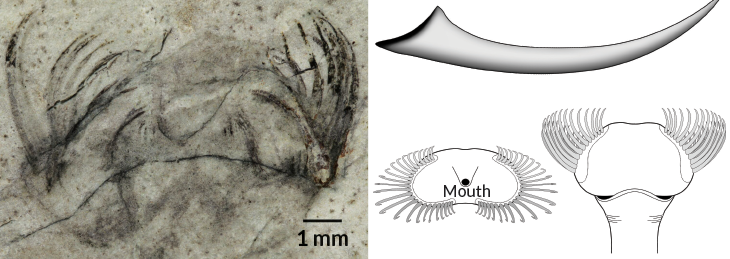
These arrow worms, which make up the phylum Chaetognatha, snatch prey with Wolverine-like claws protruding from around their mouths. Researchers now report that a newly identified species of ancient arrow worm was especially heavily armed. Dubbed Capinatator praetermissus, the predator had about 50 curved head spines, more than twice as many as most of its modern relatives. Arranged in two crescents, the spines could snap shut like a Venus flytrap to catch small invertebrates.
More than 100 species of chaetognaths are alive today, but evidence of their ancient relatives is spotty. C. praetermissus lived a little more than 500 million years ago during the Cambrian Period and was identified from 49 specimens found in the fossil-rich Burgess Shale in British Columbia, the scientists report in the Aug. 21 Current Biology. Often, only arrow worms’ clawlike spines appear in the fossil record, without soft tissue. But many of the new finds had such tissue preserved, which provided clues to body size and shape.
C. praetermissus was different enough from other chaetognaths to be labeled not only a new species, but also a new genus. The animal was at the larger end of the scale for arrow worms: about 10 centimeters from spines to tail. And while today’s arrow worms have teeth to mash up their meal after capturing it, this ancient species appears to have been toothless.
But arrow worm teeth, which are found closer to the mouth, are quite similar to spines, says study coauthor Derek Briggs, a paleontologist at Yale University. Shorter spines seen on some ancient specimens could have functioned somewhat like teeth and might have been an early evolutionary step toward tooth development, Briggs proposes.
With history as its playground, Assassin's Creed has always revelled in the perfect recreations of time periods long lost. From the spires of the Italian Renaissance to the grim gargoyles of Notre Dame, Ubi loves its true slices of history and Assassin's Creed Origins is no different. Ancient Egypt positively hums with history and creative director Ashraf Ismail is proud that Egypt's most famous landmarks across the Giza Plateau have been recreated block by sandy block for Bayek to explore.
"The pyramids took a long time. The Giza plateau had lots of iteration," he tells us at Gamescom. "We needed to nail the balance. Making sure that we actually respected the architecture. The architecture is respected almost 100%. All the chambers, all the corridors are the exact same ones. Same angles, we’ve added our own hidden chambers that have not been found yet and it’s where we infuse our lore and why would we be interested in going to the great pyramid."
Lore wise, that might be something to do with his explanation of the Assassin's Creed Origins giant snake but it'll be fascinating to see what's hiding inside these tombs. Let's hope it's not just scarab beetles - case in point, you have to follow these pesky critters to find secret rooms... "We put a lot of effort to make sure that first it worked with gameplay but it was also what is very respectful of what is known and what is there in that whole area of Giza with the Sphinx, the great pyramids, the smaller pyramids," Ismail confirms. "It took a lot of time to get right". I'm already counting down to Animus time. Two months and counting....
A close second look at a fossil has revealed a previously unknown breeding ground for an extinct whale, and potentially sheds light on how species respond to changing climatic conditions.
In a paper published in the journal PeerJ, Cheng-Hsiu Tsai of the National Museum of Nature and Science, in Tsukuba, Japan, reports on a careful re-examination of several fossils of an extinct baleen whale, Parietobalaena yamaokai, that existed around 15 million years ago.
The fossils had hall been collected over the past century from around Hiroshima, and were held in that city’s Hiwa Museum for Natural History.
Examining one of the exhibits, part of a skull, Tsai noticed that two of the bones had not knitted together fully, indicating that the animal must have been under six months old when it died.
The discovery, Tsai writes, indicates “a previously hidden and unknown breeding ground for the extinct baleen whale”.
She goes on to suggest that the breeding ground is the earliest ever identified in the northern memisphere, and that uncovering further evidence could shed light on ancient baleen whale behaviour.
“Identifying a possible Miocene breeding site for baleen whales in the northern
hemisphere also raises some interesting questions,” she concludes. “When, where, and which species of baleen whales initiated the annual, long migration between feeding and calving grounds?”
The answers to these questions could help to provide clues about the breeding grounds of modern day baleen whales – the locations of which are largely unknown.
This, in turn, will have direct application for conservation strategies.