More than 100,000 years ago in a Siberian cave there lived a child with a loose tooth. One day her molar fell out, and fossilized over many millenniums, keeping it safe from the elements and the tooth fairy.
But she wasn’t just any child. Scientists say she belonged to a species of extinct cousins of Neanderthals and modern humans known today as the Denisovans. And in a paper published Friday in the journal Science Advances, a team of paleoanthropologists reported that she is only the fourth individual of this species ever discovered.
“We only have relatively little data from this archaic group, so having any additional individuals is something we’re very excited about,” said Viviane Slon, a doctoral candidate at the Max Planck Institute for Evolutionary Anthropology in Leipzig, Germany, and lead author of the study.

The scant fossil record for these ancient hominins previously included only two adult molars and a finger bone. The Denisovans were only correctly identified in 2010 by a team of researchers led by Svante Paabo, who used the finger bone to sequence the species’ genome.
Scientists exploring Denisova Cave in the Altai Mountains discovered the worn baby tooth in 1984 and labeled it ‘Denisova 2.’ At the time, its origins were a mystery. But now, after performing DNA analysis on the deciduous, or baby, tooth, researchers say it was one of the elusive Denisovans.
“We think based on the DNA sequences that ‘Denisova 2’ is at least 100,000 years, possibly 150,000 years old. Or a bit more,” said Ms. Slon. “So far it makes it the oldest Denisovan.”
She said the baby tooth is at least 20,000 years older than the next oldest Denisovan specimen, a molar labeled ‘Denisova 8.’ It is also one of the oldest hominin remains found in Central Asia so far.
To determine the origins of ‘Denisova 2’ the team first performed a CT scan of the tooth to preserve its structure for future studies. Then Ms. Slon donned a pair of gloves and used a dentistry tool to scrape off the tooth’s surface in order to reduce contamination lingering from the cave site or where it was stored. Using a different drill bit, she drilled into its root and collected about 10 milligrams of material, which contained DNA.

After sequencing the DNA she compared genetic information from the sample with genetic data already collected from Denisovans, Neanderthals and modern humans.
“We saw it was most similar to Denisovan mitochondrial genomes,” she said. “That was exciting because that was a good indication that this was another Denisovan individual.”
Bence Viola, a paleoanthropologist from the University of Toronto and an author on the paper, said there was not too much to be learned from studying the tooth’s morphology or appearance.
The genetic analysis, on the other hand, provided the keys to learning more about the species. He said the genetic study was something the team most likely could not have done five years ago without destroying the tooth.
“For a long time we didn’t want to work on it because it’s such a small specimen,” he said.
Hot on the web
But by drilling into the tooth and performing the genetic analysis the scientists were able to not only figure out who it belonged to, but also provide relative dates for when the Denisovan lived. The study also suggests that the species had less genetic variability than modern humans, but more genetic diversity than seen in Neanderthal nuclear DNA.
Todd R. Disotell, a molecular anthropologist from New York University who was not involved in the study, said that the team’s genetic analysis was “rock solid.” He said that what he found most interesting was how old the sample was, which showed how long Denisovans lived around the cave, and the insight it provided to the species’ genetic variation.
“This is four people in one cave and they have more variation than is in the Neanderthals, which are spread over 10,000 kilometers and over several hundreds of thousands of years.”
He added that the findings help show the diversity of humanlike species that once inhabited Earth at the same time.
Dr. Bernard A. Wood, a professor of human origins at the Center for the Advanced Study of Human Paleobiology at George Washington University, said the paper demonstrated the power of molecular biology as a tool for paleoanthropology.
“Talk about extracting blood from a stone,” he said, “this is extracting treasure from a tooth.”
Source


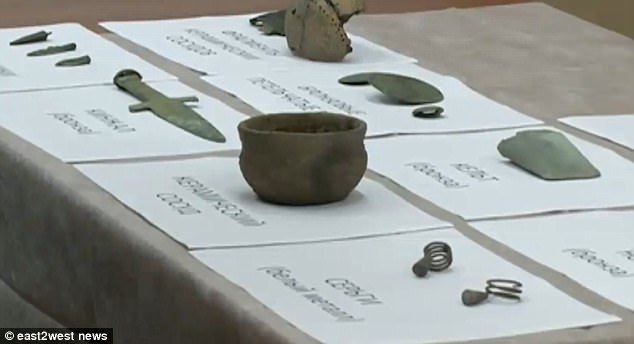 Maxim Grachev, director of Omsk Museum of Archeology and Ethnography, said a total of five burials had been found in this vicinity but the other four had been destroyed.


