Showing posts with label afro-eurasialatestposts. Show all posts

Saturday, August 5, 2017

DNA research is shedding new light on the mysterious ancient Minoan civilization on the island of Crete and their counterparts on the Greek mainland, the Mycenaeans.

The civilizations were Europe’s first literate societies and were the cultural ancestors of later Classical Greece. The Minoan civilization existed from around 2600 to 1100 B.C. and the Mycenaeans existed from around 1700 to 1050 B.C.

The Minoans have long puzzled historians. The civilization created the first European writing system and built vast palace complexes with vibrant art, but seemed to spring up in isolation, experts said.

The origins of the Bronze Age Minoan and Mycenaean cultures have puzzled archaeologists for more than a century. We have assembled genome-wide data from 19 ancient individuals, including Minoans from Crete, Mycenaeans from mainland Greece, and their eastern neighbours from southwestern Anatolia. Here we show that Minoans and Mycenaeans were genetically similar, having at least three-quarters of their ancestry from the first Neolithic farmers of western Anatolia and the Aegean1,2, and most of the remainder from ancient populations related to those of the Caucasus3 and Iran4,5. However, the Mycenaeans differed from Minoans in deriving additional ancestry from an ultimate source related to the hunter–gatherers of eastern Europe and Siberia6–8, introduced via a proximal source related to the inhabitants of either the Eurasian steppe1,6,9 or Armenia4,9. Modern Greeks resemble the Mycenaeans, but with some additional dilution of the Early Neolithic ancestry. Our results support the idea of continuity but not isolation in the history of populations of the Aegean, before and after the time of its earliest civilizations

Ancient DNA research has traced the principal ancestors of early European farmers to highly similar Neolithic populations of Greece and western Anatolia, beginning in the seventh millennium BC (refs 1, 2);  however, the later history of these regions down to the Bronze Age, a transformational period in the history of Eurasia4,6,9, is less clear. There is limited genetic evidence suggesting migrations from both the east (the area of Iran and the Caucasus), reaching Anatolia by at least  ~ 3800BC (ref. 4), and the north (eastern Europe and Siberia)  contributing ‘Ancient North Eurasian’ ancestry6,10 to all modern Europeans. The timing and impact of these migrations in the Aegean is, however, unknown.During the Bronze Age, two prominent archaeological cultures emerged in the Aegean. The culture of the island of Crete, sometimes referred to as ‘Minoan’11, was Europe’s first literate civilization, and has been described as ‘Europe’s first major experience of civilization’12. 

However, the Linear A syllabic ideographic and Cretan hieroglyphic scripts used by this culture remain undeciphered, obscuring its origins. Equally important was the civilization of the ‘Mycenaean’ culture of mainland Greece, whose language, written in the Linear B script, was an early form of Greek13. Cretan influence in mainland Greece and the later Mycenaean occupation of Crete link these two archaeological  cultures, but the degree of genetic affinity between mainland and Cretan populations is unknown. Greek is related to other Indo-European  languages, leading to diverse theories tracing its earliest speakers from the seventh millennium down to ~ 1600BC, and proposing varying degrees of population change (Supplementary Information section 1).Genome-wide ancient DNA data provide a new source of infor-mation about the people of the Bronze Age, who were first known through the ancient poetic and historical traditions starting with Homer and Herodotus, later through the disciplines of archaeology and linguistics, and, more recently, by the limited information from ancient mitochondrial DNA14,15. 

Here we answer several questions. First, do the labels ‘Minoan’ and ‘Mycenaean’ correspond to genetically coherent populations or do they obscure a more complex structure of the peoples who inhabited Crete and mainland Greece at this time? Second, how were the two groups related to each other, to their neigh-bours across the Aegean in Anatolia, and to other ancient populations from Europe1,2,6,8–10 and the Near East2–5,9,16,17? Third, can inferences about their ancestral origins inform debates about the origins of their  cultures? Fourth, how are the Minoans and Mycenaeans related to Modern Greeks, who inhabit the same area today?We generated genome-wide data from 19 ancient individuals  (Fig. 1a, Extended Data Table 1 and Supplementary Information  section 1). These comprised ten Minoans from Crete (approximately  2900–1700BC; labelled Minoan_Odigitria, from Moni Odigitria near the southern coast of central Crete; and Minoan_Lasithi, from the cave of Hagios Charalambos in the highland plain of Lasithi in east Crete). Four Mycenaeans were included from mainland  Greece (approximately 1700–1200BC; from the western coast  of the Peloponnese, from Argolis, and the island of Salamis). An additional individual from Armenoi in western Crete (approxi-mately 1370–1340BC; labelled Crete_Armenoi) postdated the appearance of Mycenaean culture on the island. Our dataset also included a Neolithic sample from Alepotrypa Cave at Diros Bay in the southern Peloponnese (about 5400 BC), adding to previously published samples from northern Greece2 (collectively labelled Greece_N). 

Finally, it included three Bronze Age individuals (approxi-mately 2800–1800; labelled Anatolia_BA) from Harmanören Göndürle in southwestern Anatolia (Turkey),  adding knowledge about genetic variation in Anatolia after the Neolithic/Chalcolithic periods1,2,4,17 (Supplementary Information section 1). We processed the ancient remains, extracted DNA, and prepared Illumina libraries  in dedicated clean rooms (Methods and Supplementary Table 1),  and, after initial screening for mitochondrial DNA, used in-solution hybridization18 to capture ~ 1.2 million single nucleotide polymor-phisms (SNPs)6,19 on the ancient samples. We assessed contamination by examining the rate at which they matched the mitochondrial con-sensus sequence (Supplementary Table 2) and the rate at which male samples were heterozygous on the Xchromosome (Methods). 

We com-bined the dataset of the 19 ancient individuals with 332 other ancient individuals from the literature, 2,614 present-day humans genotyped on the Human Origins array, and 2 present-day Cretans (Methods).We performed principal component analysis (PCA)20 (Methods), projecting ancient samples onto the first two principal components inferred from present-day West Eurasian populations10 that form two south–north parallel clines in Europe and the Near East along principal component 2. Minoans and Mycenaeans were centrally positioned in the PCA (Fig. 1b), framed to the left by ancient pop-ulations from mainland Europe and the Eurasian steppe, to the right by ancient populations from the Caucasus and Western Asia, and to the bottom by Early/Middle Neolithic farmers from Europe and Anatolia. The Neolithic samples from Greece clustered with these farmers and were distinct from the Minoans and Mycenaeans. The Bronze Age individuals from southwestern Anatolia were also distinct, intermediate between Anatolian and Levantine populations towards the bottom, and populations from Armenia, Iran, and the Caucasus

DNA DISCOVERY IDENTIFIES LIVING DESCENDANTS OF BIBLICAL CANAANITES

Clues as to their origins have proved hard to come by. While the ancient palace of Knossos on Crete offers some insight into their society, and the Minoans feature prominently in Greek mythology, their main script, known as Linear A, hasn’t been deciphered.

Now researchers from the Max Planck Institute for the Science of Human History and Harvard Medical School have drilled down into ancient DNA to find answers.  

“There is this assortment of hard archaeology, linguistics, and legends that give us some idea about what was going on in Crete during the Minoan period, which has led to many theories about where the Minoans came from,” Dr. Iosif Lazaridis, postdoctoral fellow at Harvard Medical School and the study’s lead author, told Fox News via email. “But, no hard facts, because the language was unique and unknown and it's not clear who the relatives of the Minoans were outside Crete.”

EXPERTS HUNT FOR BIBLICAL TABERNACLE THAT HOUSED THE ARK OF THE COVENANT

Researchers analyzed genomic data from 19 individuals, including Minoans, Mycenaeans, a Neolithic individual from ancient Greece, and Bronze Age individuals from southwestern Anatolia, which is in modern day Turkey. By comparing the information generated with previously published data from nearly 3,000 other people, both ancient and modern, the researchers were able to work out the relationships between the groups.

The results show that the Minoans were genetically very similar to the Mycenaeans. Individuals in both civilizations shared more than 75 percent of their ancestry with farming people that lived in Greece and western Turkey thousands of years earlier during the Neolithic period.

“This is quite remarkable – it was genetic continuity with the first farmers of Europe – they settled the region about 4,000 years prior to the Minoan and Mycenaean cultures,” Dr. Alissa Mittnik, a researcher at the Max Planck Institute for the Science of Human History, told Fox News.

ARCHAEOLOGISTS UNEARTH 2,700-YEAR OLD RESERVOIR IN ISRAEL

“This is very surprising because the Mycenaeans were in many ways culturally different than the Minoans: their tombs and art are replete with weapons, they had horses, chariots, and were very hierarchical because they buried their chieftains with copious amounts of gold and built their ‘Cyclopean’ citadels with huge limestone blocks,” added Lazaridis. “The later Mycenaeans are usually identified with the Achaeans of Homer's ‘Iliad,’ who were the people that sacked Troy.”

Lazaridis explained that the remainder of the Minoans’ and Mycenaeans’ ancestry came from Armenia, Georgia and Iran. The latter civilization’s ancestry can also be traced back to Eastern Europe and Siberia, according to the researcher, who noted that modern Greeks are quite genetically similar to the Mycenaeans.

“We may be removing some of the mystique surrounding these people by showing that they weren't that different from the people that came before or after them,” Lazaridis told Fox News. “The Minoans and Mycenaeans didn't have any special ancestry: they were made of the same basic ‘stuff’ as other people from Europe and the Middle East. So we can't answer the question of why these civilizations flourished thousands of years ago, but we can at least cast some light on who they were and where they came from.”


Source

DNA discovery unravels the mystery of early Greek civilizations

4,272 objects of cultural, historical and archaeological value illegally exported from Turkey were returned to the country thanks to the intense efforts of the Ministry of Culture and Tourism.

The most recent successful initiative is the decision to return the Heracles' Sarcophagus from Switzerland to Turkey.

Thousands of objects of cultural, historical and archaeological value were returned to the country thanks to initiatives taken since 2003.

According to the ministry of Turkey, 4,272 items illegally exported to foreign countries such as France, Austria, Great Britain, Germany, Croatia, the United Arab Emirates and Switzerland have been returned.

These objects, which returned to Turkey during the period 2003-2017, are exhibited at various museums in the country.

4,272 objects of cultural, historical and archaeological value were returned to Turkey


A bronze stylus was found in Assos, a small historic town located in the northwestern Turkish province of Canakkale.

Researchers have uncovered a 1,800-year-old writing implement, or stylus, at the ancient Greek archaeological site of Assos in northwestern Turkey.

The city was founded from 1000 to 900 BC by Aeolian colonists from Lesbos, who specifically are said to have come from Methymna. The settlers built a Doric Temple to Athena on top of the crag in 530 BC. From this temple Hermias of Atarneus, a student of Plato, ruled Assos, the Troad and Lesbos for a period of time, under which the city experienced its greatest prosperity. (Strangely, Hermias was actually the slave of the ruler of Atarneus.

St. Paul also visited the city during his third missionary journey through Asia Minor, which was between 53-57 AD, on his way to Mytilene on the island of Lesbos. Acts 20 records that Luke the Evangelist and his companions ('we') "went ahead to the ship and sailed [from Troas] to Assos, there intending to take Paul on board ... and when he met us at Assos, we took him on board and came to Mitylene".

Speaking to Anadolu Agency, the head of the Assos excavations, Professor Nurettin Arslan from Canakkale Onsekiz Mart University said the bronze instrument was pointed at one end and flat on the other.

According to Arslan, the tool which was discovered recently would have been used to write, take notes and make calculations on wax tablets used during that period.

“The flat part at the back side of the stylus was used to make corrections,” he said, likening it to today’s erasers.

Noting that students and merchants at that time used these sorts of writing tools, Arslan said that some pupils used it to write on sand or ceramic floors.

“Students who were financially better off, used it to write on wax tablets, to learn how to read and write as well as to practise their handwriting,” he said.

Merchants and the rich who did their own accounting also used these kinds of gadgets during the period, he added.

According to Arslan, one needed to be literate to own these kinds of styli. He said that not only free people but also some slaves were literate then.

“Educated slaves could also use these ... for their owners’ calculations or for certain notes,” Arslan added.

According to Arslan, as people during Roman times used wax tablets, they needed to make writing tools from hard materials. That is why bronze or bone was generally used to make styli.

The Turkish archaeologist said every period had its own stylus designs, but bronze was more commonly used during this era as it was hard.

Arslan also said that the Assos excavations had uncovered a piece from a 2,500-year-old vase, which was imported from Athens and a 2,000-year-old ceramic remnant.

Source
AA
TRT

Archaeologists discover 1,800-year-old writing tool in the ancient Greek city Assos,Turkey

Wednesday, May 24, 2017

Residents lived in Old Khndzoresk up until the 1950s
In a rural corner of southeastern Armenia, livestock walk in and out of rooms carved into the cliffside, grazing among the ancient rock-hewn homes of Old Khndzoresk, a multi-level village built into the volcanic rocks. Archaeological evidence suggests habitation of the excavated caves goes back over a thousand years, ending only recently, in the 1950s. In the early 1900s, Old Khndzoresk was the largest village in eastern Armenia, housing about 8,300 residents in 1,800 homes. 


These homes had several rooms and were all stacked upon one another; one house’s roof was the yard of the one above. The village also had seven schools, four churches, three dyeworks, several leather workshops and about 27 other shops. Residents were known to have traveled to and from different spots in the village through a series of hidden tunnels or by using ropes to climb to higher levels.

The origin of the name is up for debate. Folklore has two accounts: “khndzor” means apples in Armenian, so the village was perhaps named for the various apple trees growing there; or the name might have origins in “khor dzor,” meaning "deep canyon"—because of the cliffs the town was built into. Although researchers aren't exactly sure when the cave village was first built, written records dating to the 13th century name it on a list of villages required to pay taxes to Tatev Monastery. 
Aside from being a fascinating architectural sightseeing opportunity, Old Khndzoresk is a must for military history buffs. Mkhitar Sparapet—once a key leader of the rebellion during Armenia’s fight for liberation from Ottoman rule in the 1700s—is buried nearby. Villagers are said to have murdered him in 1730, fearing the Ottomans would target their village if he was found hiding there. His stone tomb can be found at a 17th-century hermitage near the bottom of the gorge, slightly south of the old village. 
In 1958, Old Khndzoresk’s residents moved out, having built a new village higher up the canyon. The exact reason is under dispute: Some say an earthquake in the 1930s devastated the village and left the cave dwellings unsafe, leading to a gradual departure. Others suggest the residents were forced to move by Soviet leaders, who deemed the caves uncivilized and wanted to source the rock as building material. Whatever the case may be, the families built and moved into their new town, aptly called New Khndzoresk. Today a 525-foot-long swinging suspension bridge hangs about 200 feet above the river, linking the two villages. It opened in 2012, built by locals with local materials and can be accessed by a path that leads from a viewing platform.

From the bridge, visitors can see the several historic churches once frequented by villagers, as well as a fountain, “Nine Children,” named for a local legend: Once, during an attack on Khndzoresk, women and children were needed to fight alongside the men. A widowed mother, Sona, was killed in battle, leaving behind nine children. After the attack, Sona’s father Ohan built the fountain—installing a bowl that looks like a woman’s breast. He christened the fountain with a single prayer: “I beg you sacred fountain, let the water of the fountain turn into milk and protect my orphaned grandchildren.”


Explore the town's architecture, landscapes and legends in this 360-degree interactive map, created by 360 Great Armenia:

Source

Explore an Ancient Cave City in Armenia

Tuesday, May 2, 2017

On 24 and 25 April 2017, in the center of Salamis, a chamber tomb belonging to a Mycenaean cemetery was investigated by the Archaeological Service of West Attica, Piraeus and Islands of the Ministry of Culture and Sports. Clusters of the same cemetery have been excavated in 1964, 1992 and 2009. They revealed( then) two chambers of the same tombstones as the present.


The tomb chamber, carved in the natural rock of the area, was discovered during excavation works to connect an adjacent house with the main drainage duct of the city.
It is a chamber of 2.60m x 2.90m and height of 1.50m. at its highest point. Due to the existence of rich freshwater springs in this part of the city, the void of the chamber was flooded with water, which was pumped by mechanical means to conduct the investigation.
Mycenean chamber tomb with grave goods dating to the 13th-12th centuries BCE has been discovered on the island of Salamina.

Approximately 40 intact vases were discovered, with a very good state of preservation of their written decoration and about 10 fragments, as well as skeletal material of at least five people.
The grave from a first estimate was used from the second half of the 13th to the first half of the 12th century BC.

Source/Photography/Bibliography
http://www.ancienthellas.eu

A Mycenaean chamber tomb was discovered in Salamis

Wednesday, April 19, 2017

Archaeologists in Turkey's southern Burdur province have discovered a 2,000 year-old summer palace belonging to a Roman emperor, reports said on Tuesday.

The finding sheds light on the life of Roman Emperor Marcus Aurelius, who ruled the empire between 161-180 AD, built a summer house in the Kibyratis Mountains located in modern-day town of Gölhisar and made money by exporting wine and producing pottery, archaeologists from the Austrian Archaeological Institute have reportedly told Haaretz.

The excavations revealed that there were large rural estates in the area, used by Roman nobles, including the empire.

Archaeological research in the area has reportedly been launched in 2008 and found significant remains, including mosaics, wall decorations and clay water pipes. Furthermore, it revealed that the Roman emperor's family was involved in hunting expeditions and exporting wines.

For instance, a votive altar found during the excavation describes the hunting expedition and sacrificing the animals to the gods, while a carving shows a wolf attacking a shepherd

2,000 year-old Roman emperor's summer home discovered in southern Turkey

Tuesday, April 18, 2017

After the Resurrection, this tomb is crammed with the remains of former Archbishops of Canterbury.

Last year, during the refurbishment of the Garden Museum, which is housed in a deconsecrated medieval parish church next to Lambeth Palace, the Archbishop of Canterbury’s official London residence, builders made the discovery of a lifetime: a cache of 30 lead coffins that had lain undisturbed for centuries.


Closer inspection revealed metal plates bearing the names of five former Archbishops of Canterbury, going back to the early 1600s.

Building site managers Karl Patten and Craig Dick made the find by chance, as the former chancel at St Mary-at-Lambeth was being converted into an exhibition space. Stripping some stone to even out the precarious flooring and enable disabled access to the old altar, they accidentally cut a six-inch diameter hole in the floor and noticed a hidden chamber beneath.

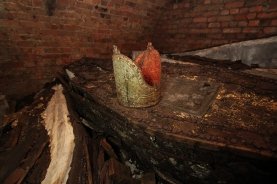
Attaching a mobile phone to a stick, they dropped it into the void. What they filmed astonished them – a hidden stairway leading to a brick-lined vault. Inside, piled on top of each other, were the coffins. On top of one rested an archbishop’s red and gold mitre.

Two had nameplates – one for Richard Bancroft (in office from 1604 to 1610) and one for John Moore (in office, 1783-1805), whose wife, Catherine Moore, also had a coffin plate. Also identified from a coffin plate was Dean of Arches John Bettesworth (who lived from 1677 to 1751), the judge who sits at the ecclesiastical court of the Archbishop of Canterbury.

St Mary-at-Lambeth’s records have since revealed that a further three archbishops were probably buried in the vault: Frederick Cornwallis (in office from 1768 to 1783), Matthew Hutton (1757-1758) and Thomas Tenison (1695-1715). A sixth, Thomas Secker (1758-1768), had his viscera buried in a canister in the churchyard.

“It was amazing seeing the coffins,” says Patten. “We’ve come across lots of bones on this job. But we knew this was different when we saw the archbishop’s crown.”
Details of the find have been kept secret for months until Easter Day to make the vault safe ahead of the museum’s grand reopening next month. As the tomb had been undisturbed for centuries, there was a fear the roof may have been unstable.

A square manhole has now been let into the chancel floor, with a glazed panel that will offer a glimpse of the steps down to the vault. The coffins – which have been left exactly where they were discovered, undisturbed – will be out of bounds, for good reason. Most lead sarcophagi contain dry remains, but some bodies decompose into a viscous black liquid known as “coffin liquor”. Should the ancient casings crack, it will spray forth.

Today, I am the first outsider to be allowed a look into the hidden tomb. I lie on the newly flattened altar, stare deep into the gloom, and point my torch at that mitre, still gleaming away on the jumbled pile of archbishops’ coffins. It is a spine-tingling view – one that astounded Christopher Woodward, director of the Garden Museum when he first heard of the discovery.

“I didn’t know what to expect,” he says. “I knew there had been 20,000 bodies buried in the churchyard. But I thought the burial places had been cleared from the nave and aisles, and the vaults under the church had been filled with earth.”


Woodward was not alone in this. St Mary’s crucial role in the history of Lambeth Palace’s most prestigious residents had been lost over time. It was originally an Anglo-Saxon church, built in 1062. Lambeth Palace was built later, in the 13th century. As the palace grew in importance, St Mary’s was overshadowed, literally and metaphorically.

There were records of archbishops being buried in the church, from the 17th to the 19th centuries. But it was thought their coffins had been swept away in 1851, when the ancient church was almost entirely rebuilt, except for its tower. Historians, Woodward included, believed the vaults had been filled in. And so they had been, except for the one beneath the holy altar, the most important spot in the building.

Woodward employed archaeologists, who photographed the coffin plates and researched burial records. Finally, last month, they came up with their staggering conclusions.

Of the identified coffins, the most important belongs to Bancroft, the chief overseer of the publication of the King James Bible. Production began in 1604 and the Bible was finally published in 1611, the year after Bancroft’s death. To find his coffin after all these centuries is astonishing.

“Archbishop Bancroft was chosen by King James I to put together a new English translation of the Bible,” says Woodward. “He didn’t write it, of course, but he made it happen, and the words he forced into print still ring out across a thousand churchyards every Sunday morning. It feels very precious to have his coffin as cargo in our hold.”

Woodward has also consulted Dr. Julian Litten, Britain’s greatest expert on ancient funerals and author of The English Way of Death. The Lambeth mitre chimed with his research into senior church funerals. Archbishops were buried with painted, gilded mitres placed on their coffins as part of their funerary achievements.

Litten concluded that the Lambeth mitre was a fine, 17th-century example. He also worked out, from the stamped plate on the casket beneath, that the coffin was made between 1775 and 1825, probably by the crown undertakers, Banting of St James’s. In other words, the mitre belonged to an older coffin, lower down in the pile, and had been moved on top of the new arrival to prevent damage.

“There is no other vault in the UK so rich in its sacerdotal (priestly) contents,” says Litten. “In short, it is the only archiepiscopal vault in the UK and, therefore, unique in the true meaning of the word.”

You might think Archbishops of Canterbury would be buried in Canterbury Cathedral. And, indeed, more than 50 of them are. But there is no rule saying their remains must be interred there. Six are buried in Croydon; three in Oxford; one in St Lawrence Jewry, in the City of London; one in Westminster Abbey; two in Winchester; and several on the Continent, from Normandy to Viterbo in Italy.

It isn’t surprising, then, that six were buried in Lambeth, residence to Archbishops of Canterbury for nearly 800 years. What is surprising is that they should be in tiny St Mary’s, rather than mighty Lambeth Palace itself.

The archbishops lived in glitzy splendour in the palace, with their own grand apartments, hall and sprawling gardens. Today, the Archbishop of Canterbury still has his own magnificent, 13th-century chapel and crypt within the palace walls. But his predecessors were buried not inside the palace chapel, but in the humble church next door.

How the old archbishops adored the church. Every time a member of the royal family visited Lambeth Palace, the bells of St Mary’s were rung. When a new rector was recruited for the church, he was often one of the Archbishop’s own chaplains or household officers.

“St Mary’s was unique as a London parish church as it was also, in effect, an annex of Lambeth Palace,” says Woodward. “This discovery opens up that whole story.”

Deconsecrated in 1972, St Mary’s pews and bells were transplanted to churches and houses across the country. It was even due to be demolished before becoming the Museum of Garden History (later renamed the Garden Museum) in 1977.

How wonderful that while St Mary’s has risen from the dead, its ancient, holy spirits are still sleeping under the altar.

Hole accidentally cut in U.K. museum floor reveals stairs to hidden tomb of five archbishops

Saturday, April 15, 2017


The Peles Castle, built between 1873 and 1914, is one of the most important monuments of its kind in Europe.


The complex is northwest of the town of Sinaia, which is 48 kilometres (30 mi) from Braşov and 124 kilometres (77 mi) from Bucharest. Nestled in the southeastern Carpathian Mountains, the complex is composed of three monuments: Peleș Castle, Pelișor Chateau, and Foișor Hunting Lodge.
It is the summer residence of the kings of Romania and was built at the request of King Carol I of Romania.

The laying of the cornerstone of the castle took place in 1875, under the cornerstone being buried a few dozens of gold coins of 20 lei (Romanian currency ), the first Romanian coins bearing the image of Charles I.

The castle has 160 rooms and several entrances and interior staircases. The central tower measures not less than 66 meters in height. Besides Peles itself, two smaller facilities, Pelisor and the Turret, have been erected.
A mural in the inner court

Peles has a theater room with a small stage and 60 seats, plus a royal box. The castle had very modern facilities for the era in which it was built. For example, the glass ceiling of the Hall of Honor is mobile and can be driven by an electric motor. Since 1883, the Castle has central heating.
Garden of Peleș Castle

Pelisor , The Guard's Chambers, The Economat Building, the Hunting Turret Building, the Stables, the Power Plant and Şipot Villa had been built next to the castle. Because of its electrical plant , Peles castle was the first electrified castle in Europe.
The castle remained the residence of the royal family until 1948 , when it was confiscated by the communist regime .
Statues in the courtyard with the Carpathians in background

History
When the King Carol I of Romania (1839–1914), under whose reign the country gained its independence, first visited the site of the future castle in 1866, he fell in love with the magnificent mountain scenery. In 1872, the Crown purchased 1,300 square kilometres (500 sq mi) of land near the Piatra Arsă River. The estate was named the Royal Estate of Sinaia. 


The King commissioned the construction of a royal hunting preserve and summer retreat on the property, and the foundation was laid for Peleș Castle on 22 August 1873. Several auxiliary buildings were built simultaneously with the castle: the guards' chambers, the Economat Building, the Foișor hunting lodge, the royal stables, and a power plant. Peleș became the world's first castle fully powered by locally produced electricity.

The first three design plans submitted for Peleș were copies of other palaces in Western Europe, and King Carol I rejected them all as lacking originality and being too costly. German architect Johannes Schultz won the project by presenting a more original plan, something that appealed to the King's taste: a grand palatial alpine villa combining different features of classic European styles, mostly following Italian elegance and German aesthetics along Renaissance lines. 

Works were also led by architect Carol Benesch. Later additions were made between 1893 and 1914 by the Czech architect Karel Liman, who designed the towers, including the main central tower, which is 66 metres (217 ft) in height. 
The collection of arms and armor has over 4,000 pieces.

The Sipot Villa, which served as Liman's headquarters during the construction, was built later on. Liman would supervise the building of the nearby Pelișor Chateau (1889–1903, the future residence of King Ferdinand I and Queen Marie of Romania), as well as of King Ferdinand's villa in the Royal Sheepfold Meadow.

The cost of the work on the castle undertaken between 1875 and 1914 was estimated to be 16,000,000 Romanian lei in gold (approx. US$ 120 million today). Between three and four hundred men worked on the construction. Queen Elisabeth of the Romanians, during the construction phase, wrote in her journal:

Italians were masons, Romanians were building terraces, the Gypsies were coolies. Albanians and Greeks worked in stone, Germans and Hungarians were carpenters. Turks were burning brick. Engineers were Polish and the stone carvers were Czech. The Frenchmen were drawing, the Englishmen were measuring, and so was then when you could see hundreds of national costumes and fourteen languages in which they spoke, sang, cursed and quarreled in all dialects and tones, a joyful mix of men, horses, cart oxen and domestic buffaloes.

Construction saw a slight slowdown during the Romanian War of Independence against the Ottoman Empire in 1877–78, but soon afterwards the plans grew in size and construction was quite rapid. Peleș Castle had its official Royal Ball of Inauguration on 7 October 1883. King Carol I and Queen Elizabeth lived in Foişor Villa during construction, as did King Ferdinand and Queen Mary during the construction of Pelișor Castle. King Carol II was born at the castle in 1893, giving meaning to the phrase "cradle of the dynasty, cradle of the nation" that Carol I bestowed upon Peleș Castle. Carol II lived in Foișor Villa for periods during his reign.

After King Michael I's forced abdication in 1947, the Communist regime seized all royal property, including the Peleș Estate. The castle was opened as a tourist attraction for a short time. It also served as a recreation and resting place for Romanian cultural personalities. The castle was declared a museum in 1953. Nicolae Ceaușescu closed the entire estate between 1975 and 1990, during the last years of the Communist regime. The area was declared a "State Protocol Interest Area", and the only persons permitted on the property were maintenance and military personnel.

Ceauşescu did not like the castle very much and rarely visited. In the 1980s, some of the timber was infested with the Serpula lacrymans. After the December 1989 Revolution, Peleş and Pelişor Castle were re-established as heritage sites and opened to the public. Today, Foişor Castle serves as a presidential residence. The Economat Building and the Guard's Chambers Building are now hotels and restaurants. Some of the other buildings on the Peleș Estate were converted to tourist villas and some are now "state protocol buildings". In 2006, the Romanian government announced the restitution of the castle to former monarch Michael I. Negotiations soon began between the former king and the government of Romania, and have not concluded yet. The castle is on lease from the royal family to the Romanian state. Peleș Castle receives between a quarter and almost a half million visitors annually.

Throughout its history, the castle hosted some important personalities, from royalty and politicians to artists. One of the most memorable visits was that of Kaiser Franz Joseph I of Austria-Hungary on 2 October 1896, who later wrote in a letter:

The Royal Castle amongst other monuments, surrounded by extremely pretty landscape with gardens built on terraces, all at the edge of dense forests. The castle itself is very impressive through the riches it has accumulated: old and new canvases, old furniture, weapons, all sort of curios, everything placed with good taste. We took a long hike in the mountains, afterwards we picnicked on the green grass, surrounded by the Gypsy music. We took many pictures, and the atmosphere was extremely pleasant.

Artists like George Enescu, Sarah Bernhardt, Jacques Thibaud and Vasile Alecsandri visited often as guests of Queen Elizabeth of Romania (herself a writer also known under the pen name of Carmen Sylva). In more recent times, many foreign dignitaries such as Richard Nixon, Gerald Ford, Muammar al-Gaddafi, and Yasser Arafat were welcomed at the castle.

The castle was featured in the 2009 film The Brothers Bloom. The exterior of the castle is used to represent a large estate in New Jersey, the home of an eccentric billionaire played by Rachel Weisz. 

Description
By form and function, Peleş is a palace, but it is consistently called a castle. Its architectural style is a romantically inspired blend Neo-Renaissance and Gothic Revival similar to Schloss Neuschwanstein in Bavaria. A Saxon influence can be observed in the interior courtyard facades, which have allegorical hand-painted murals and ornate fachwerk similar to that seen in northern European alpine architecture. Interior decoration is mostly Baroque influenced, with heavy carved woods and exquisite fabrics.
Peleş Castle has a 3,200-square-metre (34,000 sq ft) floor plan with over 170 rooms, many with dedicated themes from world cultures (in a similar fashion as other Romanian palaces, like Cotroceni Palace). Themes vary by function (offices, libraries, armories, art galleries) or by style (Florentine, Turkish, Moorish, French, Imperial); all the rooms are extremely lavishly furnished and decorated to the slightest detail. There are 30 bathrooms. The establishment hosts one of the finest collections of art in Eastern and Central Europe, consisting of statues, paintings, furniture, arms and armor, gold, silver, stained glass, ivory, fine china, tapestries, and rugs. The collection of arms and armor has over 4,000 pieces, divided between Eastern and Western war pieces and ceremonial or hunting pieces, spreading over four centuries of history. Oriental rugs come from many sources: Bukhara, Mosul, Isparta, Saruk, and Smirna. The porcelain is from Sèvres and Meissen; the leather is from Córdoba. Perhaps the most acclaimed items are the hand-painted stained glass vitralios, which are mostly Swiss.

A towering statue of King Carol I by Raffaello Romanelli overlooks the main entrance. Many other statues are present on the seven Italian neo-Renaissance terrace gardens, mostly of Carrara marble executed by the Italian sculptor Romanelli. The gardens also host fountains, urns, stairways, guarding lions, marble paths, and other decorative pieces.

Peleș Castle shelters a painting collection of almost 2,000 pieces. Angelo de Gubernatis (1840–1913) was an Italian writer who arrived in 1898 in Sinaia as a guest of the Royal Family:

Inaugurated in 1883, Peleș Castle is not only a pleasant place during summer time; it has been conceived to be also a national monument, meant to keep the trophies of the Plevna victory, which explains the simple but majestic style. The castle's courtyard – Bramantes type – with a fountain in the middle, in the most accurate Renaissance style, pleasantly surprises the visitor. The courtyard has a merry decoration, made out of plants and flowers; all round, the building's facades are animated by elegant drawings. The interior of the castle is a true wonder, due to the beauty and richness of the sculpted wood and the stained glass windows. As you get in the vestibule, you are on the Honor Staircase, in front of the most important rulers of old Romania: Holy Stephen the Great, and Michael the Brave. In a proud attitude, wearing whether a fur cap or with the gold crown on their heads, they impress through the brilliant dressing, in which the white of ermine blends with the emerald green or the red of the large mantle. On the right and on left side of the two rulers, as servant knights, four shield bearers carry the Romanian Provinces escutcheons. Inside the Queen's library, over the groups of children symbolizing poetry and science, there is the image of Ulfilas (311–383 AD) a Goth religious ruler, from the northern side of Danube River, translating the Bible in their language and bringing his contribution in spreading Christianity, a Christian apostle of the Romans, and the image of Dante Alighieri, the creator of western poetry. Passing the library and getting into the dormitory, we will meet the image of Genies and Allegories of Painting and Music, as well as a series of legendary themes. Inside the apartments reserved for the honor guests, a number of coat-of-arms were shining through their heraldic abundance, speaking about the ancestors of the Royal Family. But among all, the glass paintings from the Peleș Castle are, beyond any doubt, the most profound and shining. Here, the subjects are taken out of Alecsandri's poetry.
Museum 
Public visits are made within guided tours. One of the tours is limited to the ground floor, another adds the first floor and the complete tour includes the second floor. Admission is charged, and there is an additional photography fee. The visiting hours are from 9 a.m. to 5 p.m. Wednesday through Sunday. On Tuesdays the hours are 11 a.m. to 5 p.m. The castle is closed on Mondays. These visiting hours are subject to change by the Romanian Culture Ministry. The castle is closed in November each year for maintenance and cleaning.

The most notable grand rooms are:

Holul de Onoare (The Hall of Honour) was finished completely only in 1911, under the guidance of Karel Liman. It spreads over three floors. Walls are dressed in exquisitely carved woodwork, mostly European walnut and exotic timbers. Bas-reliefs, alabaster sculptures, and retractable stained glass panels complete the decor.

Apartamentul Imperial (The Imperial Suite) is believed to be a tribute to the Austrian Emperor Franz Joseph I, who visited the palace as a friend of the Romanian Royal Family. Hence, decorator Auguste Bembe preferred the sumptuous Austrian Baroque in style of Empress Maria Theresa. A perfectly preserved five-hundred-year-old Cordoban tooled leather wall cover is the rarest of such quality.

Sala Mare de Arme (The Grand Armory or The Arsenal) is where 1,600 of the 4,000 pieces of weaponry and armor reside. One of Europe's finest collection of hunting and war implements, timelined between 14th and 19th century, are on display. The king added pieces used in his victory against the Ottoman Turks during the War of Independence. Famous are the complete Maximilian armor for horse and rider and a 15th-century German "nobles only" decapitation broadsword. Also on display are a wide array of polearms (glaives, halberds, lances, hunting spears), firearms (muskets, blunderbusses, snaphaunces, flintlocks, pistols), axes, crossbows, and swords (rapiers, sabers, broadswords, and many others).
Grand Hall Ceiling

Sala Mică de Arme (The Small Armory) is where predominantly Oriental (mostly Indo-Persian, Ottoman and Arab) arms and armor pieces are on exhibit, many of them made of gold and silver, and inlaid with precious stones. Included are chainmail armor, helmets, scimitars, yataghans, daggers, matchlocks, lances, pistols, shields, axes, and spears.
Sala de Teatru (The Playhouse) is decorated in Louis XIV style, with sixty seats and a Royal Box. Architectural decoration and mural paintings are signed by Gustav Klimt and Frantz Matsch.
Interior

Sala Florentină (The Florentine Room) combines revived elements of the Italian Renaissance, mostly from Florence. Most impressive are the solid bronze doors executed in Rome; ateliers of Luigi Magni; and the Grand Marble Fireplace executed by Paunazio with Michelangelo motifs.

Salonul Maur (The Moorish Salon) was executed under the guidance of Charles Lecompte de Nouy, and is meant to embody elements of North-African and Hispanic Moorish style. Mother-of-pearl inlaid furniture, fine Persian Sarouk and Ottoman Isparta rugs, and Oriental weapons and armor are perhaps the most expressive elements. The salon has an indoor marble fountain.

Salonul Turcesc (The Turkish Parlor) emulates an Ottoman "joie de vivre" atmosphere—a room full of Turkish Izmir rugs and copperware from Anatolia and Persia. It was used as a smoking room for gentlemen. Walls are covered in hand-made textiles like silk brocades from the Siegert shops of Vienna.
1933 stamp


In something remarkable in comparison to most recent-era royal families, the monarchs shared a bedroom.


Sources
http://www.romaniaregala.ro/jurnal/participarea-presedintelui-romaniei-la-dineul-oficial-de-la-castelul-peles/
http://www.dunavturs.com
Paul Constantin, Universal Dictionary of Architects (Dicționar Universal al Arhitecților), București, Editura Stiințifică si Enciclopedică, 1986 p. 39.
https://en.wikipedia.org
Romanian Landmark Peles Castle Blown Up In "Brothers Bloom" Movie

Peles Castle, Romania

Sunday, April 9, 2017

The Tiger Temple in Kanchanaburi, Thailand is also known as Wat Pha Luangta Bua Yannasampanno Forest Monastery.

This monastery is a popular tourist attraction that is located about 40km from Kanchanaburi in western Thailand.

As an avid lover of animals a visit to the Tiger Temple was on the top of our daughters wish list, of things to do during our last family vacation to Thailand.

However, after reading many mixed reviews from other travelers on TripAdvisor about the Temple we were rather skeptical about going as some of the reviews said that the tigers are mistreated and possibly drugged.

Our initial plans were to take a day trip from Bangkok to visit both the Tiger Temple and Hellfire Pass.

However, after researching the area and still feeling unsure about going to the Tiger Temple we decided that we would stay a few days in Kanchanaburi to explore the other sights and attractions and ask the locals what their thoughts are of the Temple before going.

After spending a couple of days in Kanchanaburi and talking to the locals about the tigers and the Temple we were informed that it was not what we thought it to be!

“A sanctuary for tigers and tigers cubs rescued from poachers”.

However as our daughter had her heart set on seeing the tigers we decided it would be a good opportunity to go and see for ourselves.

The entrance fee to the Tiger Temple is 600 baht per person which allows you to see the tigers in the canyon and to have photos taken with each of the tigers one by one.

For an extra 1000 baht, you can have a special photo taken with the tigers head resting in your lap and another fee if you want to feed the tiger cubs.

At first the thought of sitting up close and personal with a tiger was somewhat of a daunting thought.

However as soon as we saw the tigers lying chained to the ground in the hot sun, of which most looked somewhat dazed and others fast asleep our fear soon turned to sorrow for the tigers.

The Temple claims that its tigers are rescued from poachers and live freely and amongst the monks.

From what we observed the Temple seems to be set up to please tourists.

More like a petting zoo, then a sanctuary for the tigers.

I am still undecided whether the tigers are sedated or if they are just docile from being raised and handled by humans, and not being able to live in their natural environment.

At the same time we seen the docile, sleepy tigers in the canyon, other tigers were wide awake in an area were people can pay extra money to play with them in the water.

Tiger Temple In Kanchanaburi Thailand

Friday, April 7, 2017

Herxheim, in southwest Germany, is a Neolithic site that dates back to 5300-4950 BC. Archaeologists found a mass grave that was used by the people of the Linear Pottery culture (LBK); they believe the site was a ritual center for the area. The site was discovered in 1996 when construction work uncovered bones and human skulls. The excavation ended up being a rescue dig, or salvage dig, as it had already been damaged in part during the construction work.

The structure, found at Herxheim, indicates a large village that was up to 6 hectares in size and surrounded by large ovoid pits had been dug over many centuries. Some of these pits cut into each other and created triple semi-circular areas that split into three sections. The patterns of pits suggest that there was a predetermined layout. Due to their age, they have eroded considerably; the structures inside the pits have also eroded over time, and not many still exist.

There are 80 oval pits around the settlement at Herxheim, containing the remains of both human and animals. Inside are also material goods, such as bone and stone tools, pottery, and decorative artifacts. Interestingly, remains of whole dogs have been found intact in some of these pits.

Using an equation called “minimum number of individuals,” which is a quantification process, the researchers decided that the site contains up to 500 humans, ranging from infants to the elderly. However, only half the site has been excavated so far. Few human remains in the pits are intact, and many were shattered and had been dispersed across a pit.

The people who resided in Herxheim in the Neolithic period were known to practice a style of burial called “secondary burial”. This means that the whole of the corpse or partial pieces of it are removed and placed elsewhere. It is also possible that they practiced “sky burials,” in which some parts of the decomposing bodies may have been allowed to be carried off by scavengers. In 2006, a study of the bones revealed that many had been intentionally broken and cut apart, either at death or just after, and stone tools were most likely used to achieve the breaks that have been observed. The study concludes that Herxheim was most likely a ritual mortuary center, otherwise known as a necropolis, where the remains of the dead were destroyed, for reasons as of yet unknown.

A study in 2009 confirmed many of the 2006 findings, as one pit that had been discovered contained 1906 bones and bone fragments that belonged to 10 individuals, ranging in age from infants to the elderly. It was soon obvious that many of the bones had been singled out for their marrow content, and this suggests that a form of cannibalism was practiced there.
Due to the presence of marks and damage to the bones from impact, it is believed that the bodies were defleshed before the bones were shattered and broken.

The skulls were treated in a similar manner, with many of them struck in a way that caused them to fracture into symmetrical shapes. On many, the vault of the skull was preserved. It is not known at this point why these people used such a ritualistic method of burial. Many theories are being shared about why this site exists, including ritual sacrifice or religious use, but it is still very unclear at present.

Herxheim, an archaeological site in southwest Germany, was a ritual center and mass grave from the Neolithic Era

Wednesday, April 5, 2017

A 3,800-year-old pyramid found with an alabaster block bearing the name of pharaoh Ameny Qemau has been discovered at the site of Dahshur in Egypt.


Another pyramid containing artifacts bearing the name of Ameny Qemau (also spelled Qemaw) was discovered in 1957 in Dahshur, a royal necropolis in the desert on the Nile River's west bank. The finding has left Egyptologists with a mystery as to why the same pharaoh seemingly has two pyramids to his name.

The remains of the pyramid's inner structure were discovered by a team of Egyptian archaeologists and announced today (April 4) by the Egyptian Ministry of Antiquities.
This block was found within the 13th dynasty pyramid in Egypt and bears the name of pharaoh Ameny Qemau, who ruled about 3,800 years ago.
Credit: Egyptian Ministry of Antiquities

Within the inner structure, the team discovered an alabaster block containing 10 lines of hieroglyphic writing. The ministry said it had not yet deciphered the writing on the block.

 Both James Allen, a professor of Egyptology at Brown University, and Aidan Dodson, a research fellow at the University of Bristol, said  that inscribed on the block is a type of religious text used to line the walls of pyramids, and that it bears the name of the pharaoh Ameny Qemau.

"He was the fifth king of Dynasty XIII and ruled for about two years, [around] 1790 B.C.," Allen said.

Thomas Schneider, a professor of Egyptology and Near Eastern studies at the University of British Columbia, also agreed that the name of the pharaoh on the hieroglyphic inscription is Ameny Qemau. "The resolution of the photo is not very good; however, I believe I can read the name of Ameny Qemau," he said.


Dodson, who co-authored a 1998 paper on the artifacts from the Qemau pyramid discovered in 1957, noted the peculiarity of two pyramids holding the pharaoh's name.

Why both pyramids would have artifacts bearing the name of the same pharaoh is a mystery, Dodson said. Perhaps, the newly found pyramid doesn't actually belong to Ameny Qemau, but rather to one of his predecessors, he said. Along that line of thinking, perhaps upon rising to power, Qemau chiseled out the name of his predecessor on the block and inserted his own name instead, Dodson said. The hieroglyphic symbols representing the name of Ameny Qemau are of poor quality, indicating that the carver had to inscribe them over a chiseled-out area, Dodson added.

"Why Ameny Qemau would have added his name is unclear, as Ameny Qemau's actual pyramid was found in 1957," Dodson said.

The antiquities ministry said in a statement that excavations of the pyramid are not yet complete and that "further excavation is to take place to reveal more parts."

2nd Pyramid Bearing Pharaoh Ameny Qemau's Name Is Found

Popular Posts

Translate

Followers