Showing posts with label India. Show all posts

Monday, August 28, 2017


Archaeologists in Andhra Pradesh have discovered an ancient Buddhist site that dates back to 1st century AD.

The site was discovered atop a hill in Guntur district, in Putlagudem village of Achampet mandal.

A team headed by senior archaeologist and CEO of Culture Centre of Vijayawada and Amaravati (CCVA), Dr E Sivanagi Reddy found the site. 

“We found the Buddhist site atop a hill, locally called Bhairava Gutta. The area was dotted with broken pillars of Silamandapa in front of the dilapidated Venkateswara temple.The structures date back to the Satavahana rule," Reddy told TOI.

The Deccan Chronicle reported that the site had six limestone pillars with half lotus medallions and depicted animals and patterns.

Andhra Pradesh is home to several Buddhist sites, that date back to several centuries ago.

Just last week, one of the prime Buddhist tourist spots in the state in Ghantasala village in Krishna district, was all set to receive a boost, with a Rs 1,500 crore project.

“The new facility will be themed on the Mahaparinirvana of the Buddha. A two-storied structure in Buddhist architecture resembling a pedestal with a 100-ft wide and 70-ft high Buddha in the Mahaparinirvana posture will be a major highlight,” Executive Director of the AP Tourism Development Corporation Mallikarjuna Rao told The Hindu.

There are also plans for a 'Buddhist circuit' being drafted by the AP Tourism and Culture department.

“Under Swadesh Darshan scheme, the state government will develop five places including Amaravati, where the government will construct tourism amenities centre, parking slots, Dhyana Buddha vanam (meditation halls) and more. The tourism department is taking utmost care on the new constructions and we are ensuring that these constructions should replicate the original Buddhist structures," secretary for tourism and culture Mukesh Kumar Meena told media persons. 

Buddhist site discovered on hilltop in Guntur district of Andhra Pradesh

Tuesday, July 11, 2017

A deity has just put an end to visitors thronging one of the world’s top stoner destinations.
An isolated village nestled in the Himalayas, Malana is popular for Malana Cream, a strain of cannabis with a high oil content and intense aroma. Over the decades, this village of over 4,700 residents had emerged as a much sought-after destination among tourists thanks to its premium quality hashish.

Malana Cream is among the most expensive hashish on the famed cannabis menus of Amsterdam. A tola, or 11.66 grams, sells for over $250 there and over Rs4,000 ($60) in India.

Now, however, an oracle chosen by the villagers to communicate with their god, Jamlu, has asked them to close down all guest houses and restaurants to protect local culture and traditions, the Hindustan Times newspaper reported on July 11. According to their beliefs, locals stay away from eating, staying, or marrying outside the community.

“The deity did not want any of the villagers to rent out their property for running guest houses and restaurants…those violating his orders will have to bear the brunt of his curse,” Malana panchayat head Bhagi Ram told the Hindustan Times newspaper.

The village parliament had earlier mulled over the threat to Malana’s culture, especially from the tourists. A few months ago, the village banned photography, believing that the pictures taken by the tourists were instrumental in portraying the village as a narco-tourism hub.

Located in the Parvati Valley, a favourite locality among young Israelis, nearly 240 hectares (593 acres) in Malana are under cannabis cultivation, producing over 12,000kg of hashish in 2016. Malana villagers consider themselves descendants of the soldiers of the Macedonian conqueror Alexander. They once specialised in baskets, ropes, and slippers made from hemp, and had turned to hashish after foreign tourists taught the villagers how to extract the resin from cannabis.

Cannabis is illegal in India, but it also dominates India’s illicit drug trade; no other narcotic comes close. Last year, the country seized over 182,622kg of ganja and 2,489kg of hashish.

Source

An ancient Himalayan village known for India’s best hash is now off limits for tourists

Wednesday, June 28, 2017

The Palkhi Festival of India dates back 1,000 years. Religious devotees in Maharashtra, the state that is home to Mumbai, make a pilgrimage over 23 days. Your Shot photographer Mahesh Lonkar saw the festivities one night. "I saw beautiful yellow light from my balcony," he remembers. "Devotees [were] performing collective singing, chanting, [and] shopping around the temple with enthusiasm for their creator."

Palki festival showcases the distinctive feature of the Maharashtrian culture. This is a 1000-year-old tradition, which has been following by the warkaris (people who follow the wari, a fundamental ritual).

People perform collective singing, dancing, chanting (Dnyanba-Tukaram in what are called as Dindis or organised group of warkaris) to the holy town of Pandharpur in Hindu months of Ashadh (June-July) and Karthik (November-December).

Palkhi Festival, which lasts for 22 days, starts in the month of Jyeshth (June). Every year on the eleventh day of the first half of the month of Ashadh, the Palkhi reaches Pandharpur. Every saint, right from Sant Jyaneshwar to Sant Tukaram was following the wari tradition.

It was in the year 1685 that Tukaram's youngest son, Narayan Baba wished to bring some change in the dindi-wari tradition by introducing the Palkhi, which is a sign of social respect.

In coarse of time, this tradition is becoming popular day by day. Nearly 1.5 lakh devotees proceed along with the Sant Tukaram Palkhi from Dehu village, while a total of 2.25 lakh devotees march along with the Sant Jnyaneshwar Palkhi.

Source/Photography/Bibliography
Photograph By Mahesh Lonkar, National Geographic

The Palkhi Festival of India

Monday, October 31, 2016

Date:ca. 1st century B.C.
Culture:India
Medium:Gold
Dimensions:H. 1 1/2 in. (3.8 cm); W. 3 in. (7.6 cm); L. 1 9/16 in. (4 cm)
Classification:Jewelry
Credit Line:Gift of John and Evelyn Kossak, The Kronos Collections, 1981
Accession Number:1981.398.3

This exquisite pair of gold earrings in rare in having survived. While splendid jewelry adorns the regal and divine figures represented on early stone sculptures and terracotta plaques, few actual ornaments still exist. It is thought that jewelry was not kept and reused but instead was melted down possibly to avoid transmitting the karma of the former owner. In addition to clusters and rows of beads, each earring is decorated with a winged lion, and elephant and two vases filled with vegetation. Put on by slipping through a distended earlobe from the back, they are worn with the lion facing the wearer's cheek and the elephant on the outside. 

The place of these earrings in the history of Indian art is assured, not only for their intrinsic beauty, but also because of the light they shed on the superb quality of early gold-smithing in this region. Early Indian statues of both male and female figures were usually portrayed with elaborate jewelry that sometimes seemed fanciful, since very little comparable jewelry from that period survived. The discovery of this pair of earrings provided the first tangible evidence that the jewelry depicted by the sculptors was in fact based on real exemplars, for a very similar pair is shown on a first century B.C. relief portrait of a Universal Ruler, the Chakravartin, from Jaggayapeta. 

These earrings, judging from their material worth, the excellence of craftsmanship, and the use of royal emblems (a winged lion and an elephant) as part of their design, were most probably made as royal commissions. Each earring is composed of two rectangular, budlike forms, growing outward from a central, double-stemmed tendril. The elephant and the lion of repoussé gold are consummately detailed, using granules, snipets of wire and sheet, and individually forged and hammered pieces of gold. The two pieces are not exactly identical: On the underside they are both decorated with a classical early Indian design of a vase containing three palmettes, but the patterning of the fronds differentiates the two earrings. They are so large and heavy that they must have distended the earlobes and rested on the shoulders of the wearer, like the pair worn by the Chakravartin.


One from a Pair of Royal Earrings

Sunday, June 19, 2016


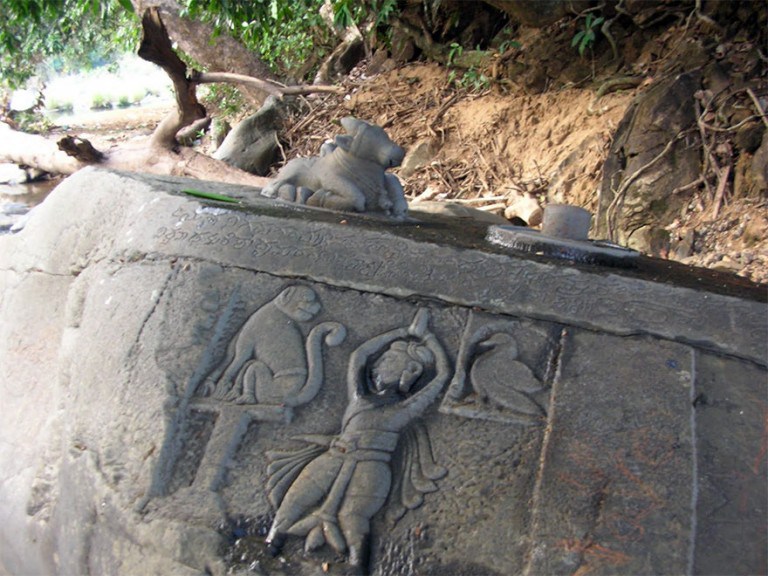
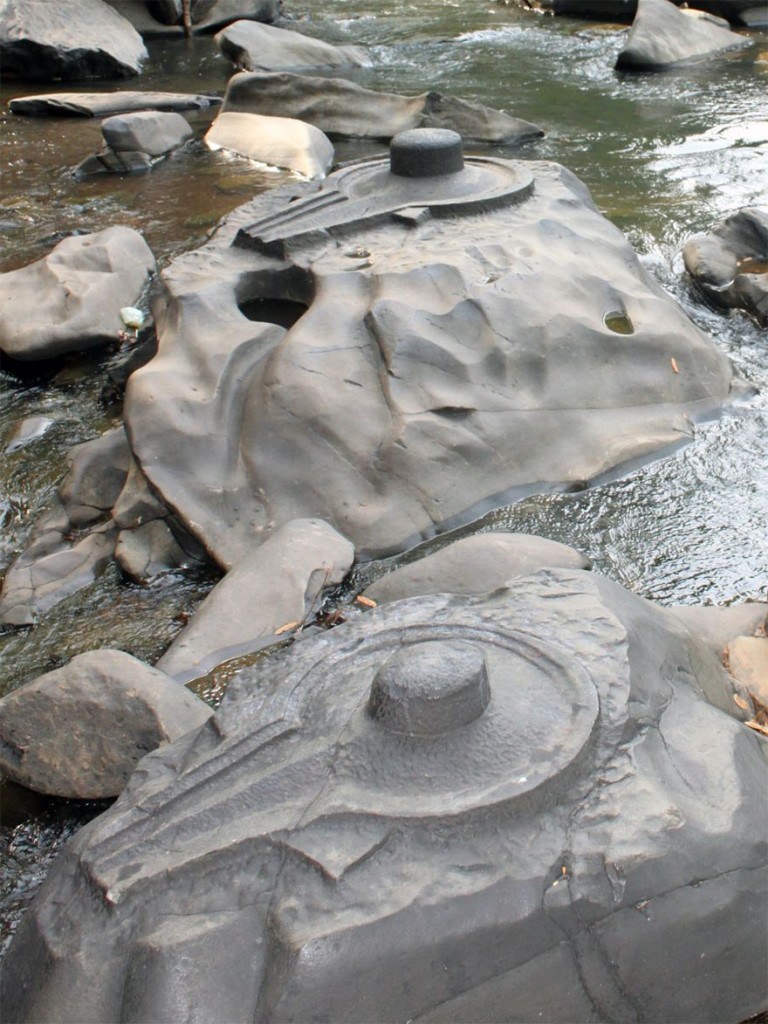
For the first time in history, a combination of drought and overconsumption of water have pushed the river in India, the Shamala river in Karnataka to its limits, revealing under its bank secrets that have shocked the archaeological community.

The receding river has revealed the presence of thousands of Shiva Lingas which were carved in the distant past along the river bed.
The place referred to as “Sahasralinga” (thousand Shiva Lingas in Sanskrit) has become an extremely important pilgrimage site and thousands of people visit Sahasralinga offering their prayers to Lord Shiva. Shiva Lingas or the Lingam is a representation of the Hindu deity Shiva, it issued in temples for worship.

Located near Sirsi, in the state of Karnataka, Sashasralinga is one of the most beautiful places in the entire country, representing divine power, and positive energy. The countless shiva lingas discovered due to the draught are proof that there are a number of places on our planet that still hold secret of our ancestors, secrets that are slowly but surely coming out into the world, so we can hopefully preserve them adequately and pay respect to their tradition and historical value.


The Indian River Drains Out For The First Time Revealing Incredible Ancient Secrets

Monday, May 23, 2016

World Heritage Monuments of Khajuraho, Madhya Pradesh, India
The temples at Khajuraho were built during the Chandella dynasty, which reached its apogee between 950 and 1050. Only about 20 temples remain; they fall into three distinct groups and belong to two different religions – Hinduism and Jainism. They strike a perfect balance between architecture and sculpture. The Temple of Kandariya is decorated with a profusion of sculptures that are among the greatest masterpieces of Indian art
The Khajuraho Group of Monuments is a group of Hindu and Jain temples in Madhya Pradesh, India, about 175 kilometres (109 mi) southeast of Jhansi. They are one of the UNESCO World Heritage Sites in India.  The temples are famous for their nagara-style architectural symbolism and their erotic sculptures.
Most Khajuraho temples were built between 950 and 1050 by the Chandela dynasty.  Historical records note that the Khajuraho temple site had 85 temples by 12th century, spread over 20 square kilometers. Of these, only about 20 temples have survived, spread over 6 square kilometers.  Of the various surviving temples, the Kandariya Mahadeva Temple is decorated with a profusion of sculptures with intricate details, symbolism and expressiveness of ancient Indian art. 
The Khajuraho group of temples were built together but were dedicated to two religions—namely Hinduism and Jainism—suggesting a tradition of acceptance and respect for diverse religious views among Hindus and Jains.  

https://commons.wikimedia.org/wiki/User:Blessedapples
Vincent Ko Hon Chiu
https://en.wikipedia.org
Aneta Ribarska
http://whc.unesco.org/

Khajuraho Group of Monuments

Popular Posts

Translate

Followers