Showing posts with label Anatolia. Show all posts

Saturday, September 16, 2017


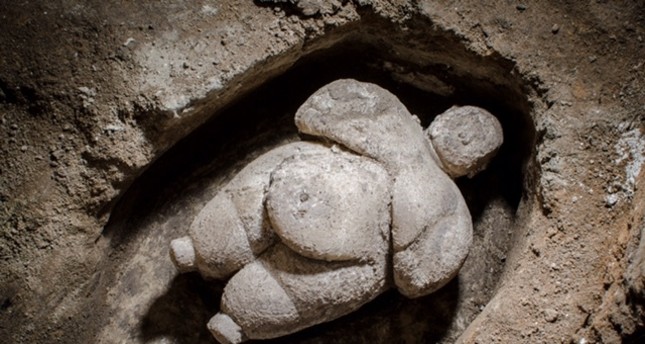
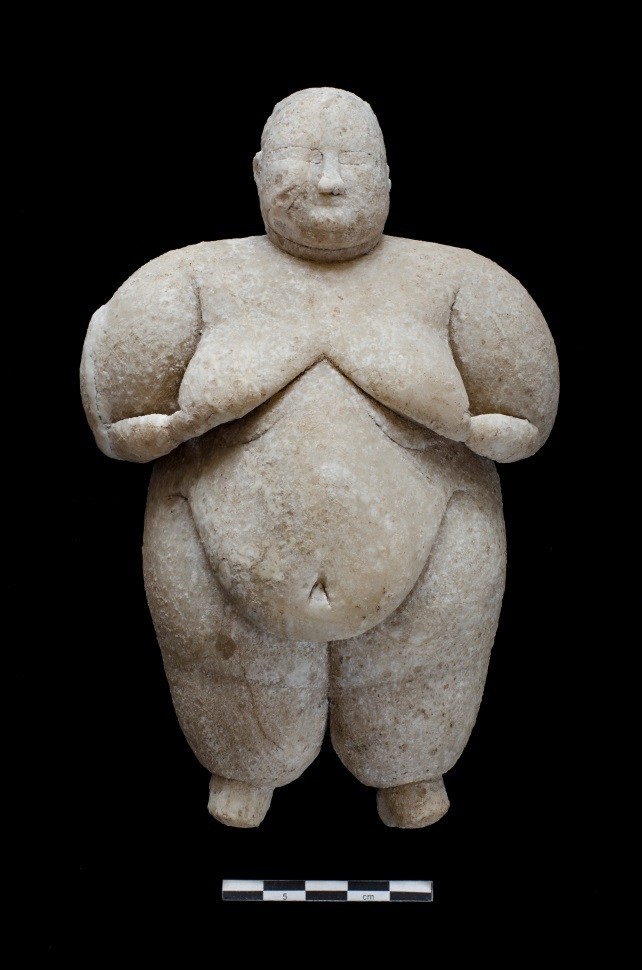
Archaeologists at Turkey's neolithic site of Çatalhöyük in central Anatolia have unearthed a "unique" complete female figurine, The Ministry of Culture and Tourism said on Tuesday.


The statuette, measuring 17 centimeters (6.7 inches) long and weighing one kilogram (2.2 pounds), is considered unique due to its intact form and fine craftsmanship; it dates back to about 5500-8000 BC, a statement said.

The figurine, which is made of marmoreal stone and considered to be part of a ritual, was discovered by the international team of archaeologists working on site led by Professor Ian Hodder, anthropologist at Stanford University in the U.S.
One of the world's first urban centers which dates back 9,000 years, Çatalhöyük is included in the 2012 UNESCO World Heritage List.
"Çatalhöyük has been the subject of investigation for more than 50 years. Researchers from around the world have travelled to the site over the past half-century to study its vast landscape of buildings, remarkable ways of life, and its many exquisite works of art and craft.

"Since 1993, the Catalhoyuk Research Project has recruited an international group of specialists to pioneer new archaeological, conservation and curatorial methods on and off site. Simultaneously, it aims to advance our understandings of human life in the past," according to the official website.


loading...

Neolithic figurine, over 7,000 years old, unearthed at Turkey’s Çatalhöyük

Friday, September 8, 2017

Clay tablets dating back 4,000 years show the beginning of writing and literacy in ancient Anatolia, in the middle of modern-day Turkey, according to researchers.

Excavations in the province of Kayseri, southeast of Turkey's capital Ankara, at an ancient settlement or burial mound shed light on writing from around the year 2000 B.C., said Fikri Kulakoğlu, a professor of archeology at Ankara University and head of the excavation team.

In 70 years of excavations at the Kültepe settlement, 25 kilometers (15.5 miles) northeast of Kayseri, some 23,000 cuneiform-script tablets have been found.

"These are the first written tablets in Anatolia. Anatolian people learned how to read and write in Kültepe. The first-ever literate people in Anatolia are from Kayseri," said Kulakoğlu.

Many of the tablets excavated are exercise tablets, apparently used by children to practice their writing.

The reading exercises in scripted tablets are signs of school-like instruction, he said.
loading...

4000-year-old clay tablets discovered in central Turkey

Sunday, September 3, 2017

Excavation teams, using information from famed Ottoman explorer Evliya Çelebi's travel guide, are continuing work along one of Anatolia's longest underground water passageways in northeastern Turkey, unearthing the lost history of a millennium old Turkish neighborhood in the process.

Atatürk University-sponsored archaeological digs have been ongoing in the Mengücekliler district of northeastern Turkey's Erzincan for the past six years, especially around Kemah Castle, an area where early Turks migrated from Central Asia.

With assistance from the Turkish Ministry of Culture and Tourism, significant historical monuments and remains have been unearthed throughout the excavations.

Among Anatolia's longest historical water tunnels, which stretch for about 350 meters between the Kemah castle and the Tanasur stream, a 1,000-year-old Turkish neighborhood has been one of the teams' major discoveries.
Dr. Hüseyin Yurttaş, head of Atatürk University's Art History department, told Anadolu Agency that a book entitled "Seyahatname" (Book of Travel) by Evliya Çelebi has been a guide to the excavation work.

Yurttaş said that according to Çelebi's book, there were 600 homes in the castle, as well as 11 houses of worship and 3 minarets.

"We have slightly departed from what Evliya Çelebi told us, and have started guiding that path ourselves. We discovered an approximately 1,000-year-old Turkish neighborhood through the excavations in Kemah."

The excavations have revealed that there were water tunnels in the upper Euphrates region, beginning from the Kemah Castle at a height of 1,053 meters above the sea level and moving to the Tanasur stream, down to a level of 50-60 meters, which indicates the water needs of past residents.

                      HOT ON THE WEB
http://thrgo.pro/?rid=-6AAAAAAAE6RUBAAAAAAAAAAQaFiaiAAAA
Emphasizing that one of the most important historical features of Kemah Castle were these tunnels, Yurttaş continued, "These water passageways were built with vaults in place."


"The tunnels are the longest in Anatolia, and according to our measurements, the tunnels stretch to around 350 meters still today. Because they are in ruins, it is difficult to reach them, but they are most visible from Kemah Castle," he said.

An assistant in the excavation team, Muhammet Lütfü Kındığılı, also said that they had discovered the structure of a kiln, which alluded to the production of ceramic pieces belonging to the Byzantine period from the 12th and 13th centuries.

Evliya Çelebi was an Ottoman traveler, who voyaged through Ottoman territory and neighboring lands over a period of forty years in the 17th century. He recorded his commentary in a ten-volume travelogue called the "Seyahatname."

Born in Constantinople in 1611, Evliya was a devout Muslim opposed to fanaticism, who could recite the Quran from memory. He was employed as an entertainer to the Ottoman court, but eventually refused employment that would keep him from travelling.
loading...

Using Evliya Çelebi's travelogue, excavation team discovers 1,000-year-old Turkish neighborhood

Monday, August 28, 2017

An underwater ancient city in Turkey may be opened up to holiday-makers for the first time in 30 years as the Turkish government aims to boost tourism to the country.

The sunken ruins of ancient Simena, which was destroyed by earthquakes during the second century, lie just off the coast the small uninhabited island of Kekova.
Kekova is a small rocky island in the Mediterranean Sea just off the mainland’s Antalya Province — the centre of Turkey’s tourism industry. Kekova also draws great attention from tourists for its clear water and sea creatures and is one of the leading spots for boat tours.

But since 1986, the island’s most curious attraction has been all but closed off for exploration. While it is possible boat or kayak around the area, and dive nearby, underwater exploration has been banned since 1986 as part of a series of measures to protect the lost city’s heritage.

Turkey declared the region a Specially Protected Area in 1990, and in 2000 submitted Kekova to UNESCO for consideration as a World Heritage Site. It currently sits on the organisation’s Tentative List.
UNESCO describes Kekova as “a rarely seen attraction” but a “remarkable example of cultural continuity, and a living cultural assents”.
But now the Antalya Mayor wants to overturn the ban and open it up to a growing diving tourism market.
Applications have been made to the Culture and Tourism Ministry and the Ministry of Environment and Urbanization for a partial removal of the ban to allow restricted diving under the guide of archaeologists, so as not to damage the sunken ancient city.
“Not only Kekova, but all the coasts of Antalya are rich in terms of archeology. Our efforts to diversify tourism alternatives have begun to bring results and interest in diving tourism has increased,” Mayor Münir Karaloğlu told Turkish news publication, Hurriyet Daily News.

“If permission is received from the ministries, diving tourism will be available with the help of guides and archaeologists in Kekova.”
The ancient underwater city is home to rich historical heritage, including inscriptions with the Lycian alphabet, tombs, the ruins of breakwaters and structures, a rock-carved theatre from the Middle Age, water cisterns, a necropolis of rock tombs and an ancient harbour.

And considering much of the sunken ruins are still high enough that they can be seen from the surface, diving tours won’t be restricted to experienced divers.
Levent Işık of the Kekova Diving Centre says a lift on diving restrictions could transform the island.
“The potential for tourists to dive this site is of great interest to all who wish to find out more about our heritage”.
“Once this ban has been lifted it will have a tremendous impact as many underwater archaeologists and universities will want to come and see more of the secrets that the 4000 year old civilisation had.”

Sunken ruins of ancient city in Turkey may soon be opened up to explore

Wednesday, August 23, 2017

Construction workers in Istanbul's Beşiktaş district digging the ground for a new metro project connecting Istanbul's Kabataş-Beşiktaş-Mecidiyeköy-Mahmutbey districts have discovered human bones and cremated remains from the eighth and 12th centuries B.C.

According to a report by the Habertürk Daily, teams from the Istanbul Archaeology Museum have been conducting excavations over the past year.

Led by museum director Zeynep Kızıltan and with the participation of archaeologists and 45 workers, the excavation revealed details of cremation practices during the Iron Age.

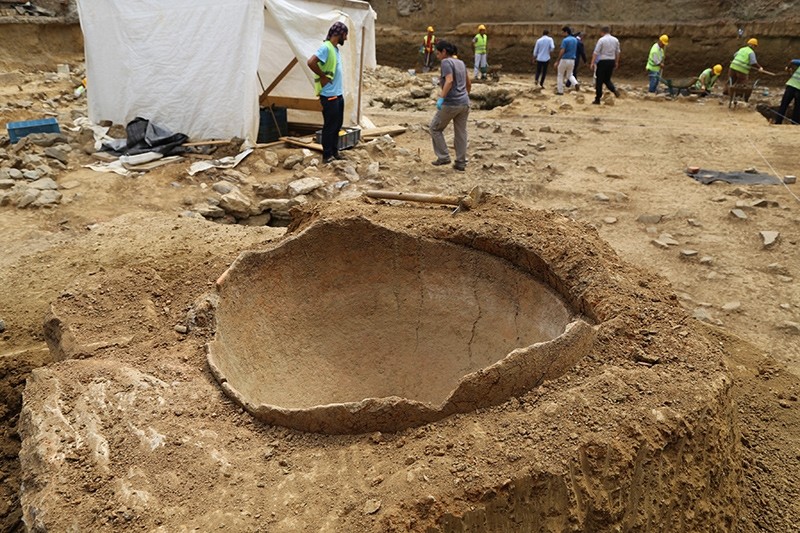
Accordingly, the ancient people preserved the cremated human remains in terracotta urns and buried them.

Kızıltan noted that the team has discovered three human skeletons at the site, which have been buried according to practices used by the people who migrated from the Black Sea region.
She explained that many people were forced to migrate from the northern Black Sea region, around Crimea as a result of climate and war, seeking refuge in Anatolia.

"We don't know which background the people who lived around the Black Sea came from" Kızıltan said, adding that some of those who fled the area came to Istanbul through Thrace.

The findings shed light on 3,000 to 3,500 years of human history, Kızıltan noted and added that DNA tests will be carried out to find out more about the ethnicity of the people, and to properly identify the gender and age, as well as the diet of the people who lived during the Iron Age.

The Iron Age around the Near East is believed to have begun with the discovery of iron smelting techniques around Anatolia in the second century BC.

Infrastructure work in Istanbul, and in various places throughout Turkey, require archaeological excavations before breaking ground, as the country was home to numerous civilizations.

Discovery of ancient human remains in Istanbul metro construction site

Saturday, August 19, 2017

Pieces that have fallen from ornaments carved on big stones 2,700 years ago in the Ayanis Castle, built by the Urartian King Rusa II on a hill overlooking the Lake Van, are being attached to their original places with special materials. 

The places of the pieces have been determined by restorers and sculptors after a two-year work.

An important and special Urartian temple with its stone and adobe workmanship as well as the adornments on its walls, Ayanis Castle has been undergoing excavation works headed by Erzurum Atatürk University’s archaeology department’s Professor Mehmet Işıklı. A team of 25 people from Erzurum Atatürk, Dokuz Eylül, Van Yüzüncü Yıl, Batman, Eskişehir, Anadolu and Ordu universities are working in the field.

New structures and artifacts unearthed during excavations carried out in the castle in the past 28 years give important clues about life 2,700 years ago. 

Işıklı said this year they focused on preservation and restoration works in the castle and around, and that the Haldi Temple and sella structure that were unearthed in the castle 20 years ago are the most special parts of the Urartian castles. 

Stating that the detailed restoration works on ornamentations and decorated stones in the temple field were continuing, Işıklı noted that it was a very troublesome and demanding work. 

“Our experts have been busy with finding the places of pieces falling from the big ornamented stones for two seasons. Once they find the original place, they attach the pieces with restoration materials,” he said. 

Işıklı said finding the places of the pieces one by one was a very difficult task.

“Now we attach these small pieces to their places. The same work will be carried out in the other parts, but at first we have to complete the missing parts with drawings. It is very hard to restore the whole temple like this. We will finish one field this year with our own efforts. Then with the support of some institutions, we will finish the restoration inside and open the temple to visitors. The temple will have a healthier environment,” he added. 

He said 28 years have passed since the start of the excavations, in which they obtained important information about the temple.

“A roof was made for better preservation. When the roof is completed, we accelerated the restoration works. When the project is finished, people will be able to visit the temple and the walls. We also have the second stage of the project, approved by the Cultural and Natural Heritage Conservation Board. We will construct a partial walking route. We will propose to the ministry to make the Ayanis Castle an archaeological site,” he added.

source

Ancient ornamentations being restored in Van

Friday, August 18, 2017

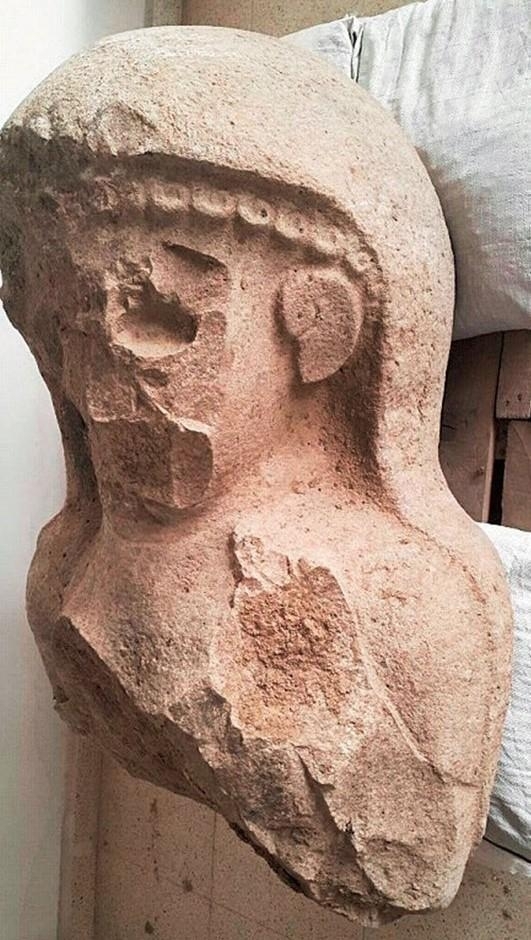
Excavations in southeastern Turkey have uncovered a massive 3,000-year-old statue, partially destroyed in what appears to have been a ritual act of iconoclasm, that is believed to depict either an Iron Age goddess or a political leader.

The statue would have been between 4 and 5 metres tall from tip to toe, but only the head and shoulders remain. The statue shows a woman's head with curls of hair emerging from under a loose shawl

The artefact is thought to date from the early 9th century BCE. It was found near the gate complex at the entrance of the upper citadel of Kunulua, later known as Tayinat. The city was the capital of the Neo-Hittite Kingdom of Patina.

It is not known in whose image the statue was carved, but there are several options the archaeologists are considering.

"It is possible that she is a representation of Kubaba, divine mother of the gods of ancient Anatolia," said archaeologist Timothy Harrison, director of the University of Toronto's Tayinat Archaeological Project, in a statement.

"However, there are stylistic and iconographic hints that the statue represents a human figure, possibly the wife of King Suppiluliuma, or even more intriguingly, a woman named Kupapiyas, who was the wife – or possibly mother – of Taita, the dynastic founder of ancient Tayinat."

Kupapiyas was the only known named female from this region in the first millennium BCE. She was said to live for more than 100 years and was an important matriarch in Tayinat society.

"The discovery of this statue raises the possibility that women played a more prominent role in the political and religious lives of these early Iron Age communities than the existing historical record might suggest."

The statue was not in a good state when it was discovered. Its face and chest had been partially destroyed, possibly as part of a ritual thousands of years ago the archaeologists say. But despite this, the pieces of the eyes and nose of the statue are seem to be present.

The statue is thought to have been destroyed along with many others guarding the Kunulua gateway in 738 BCE, when the Assyrians conquered the area.

"Scholars have long speculated that the reference to Calneh in Isaiah's oracle against Assyria alludes to their devastation of Kunulua," said Harrison. "The destruction of the Luwian monuments and conversion of the area into an Assyrian religious complex may represent the physical manifestation of this historic event, subsequently memorialised in Isaiah's oracle."

But despite this, the archaeologists are confident that they will be able to reconstruct the face of the statue, which could shed light on her identity.

"The recovery of these tiny fragments will make it possible to restore much if not all of the face and upper body of the original figure," said Harrison.

Huge Ancient Statue of Mystery Iron-Age Goddess Discovered in Turkey

Sunday, July 2, 2017

Archaeologists have discovered what seem to be the remains of a "skull cult" in an ancient ritual site in southeast Turkey.

More than 9,000 years ago — before the existence of the hanging gardens of Babylon, pyramids of Egypt, or Stonehenge — Neolithic, Stone Age people gathered at the site, called Göbekli Tepe.

No one is exactly sure why. But a new study published in the journal Science Advances by researchers from the German Archaeological Institute suggests that the location had some kind of ritualistic significance.
There is no sign that humans buried their dead there, but there are at least 691 shards and chunks of bone. At least 408 of those fragments come from human skulls.

The site also boasts monumental buildings with "monolithic T-shaped limestone pillars, an impressive repertoire of limestone sculptures, low and high reliefs," all in a prominent location, according to the study.

In the study, the research team writes that skull fragments from at least three individuals show signs of deliberate modification.
Deep grooves run across the forehead of some bones, going around the back of at least one. One skull has a hole drilled in it. None of these markings comes from decapitation or from taking the flesh and tissue off the bones, though other marks attest to this. Instead, they seem to have been inflicted shortly after death.

That indicates the skulls were somehow on display, perhaps even hung so that visitors would see them dangling.
Similar remains have been found in other archaeological sites where there was some worship of skulls, including sites in ancient Anatolia and the Levant.

People have long venerated human skulls for several reasons — some worshipped ancestors, and others believed the dead could protect the living. Some groups also displayed the skulls of their enemies.

Anthropologists refer to these practices — where there seems to be religious or ritualistic practice and treatment done to skulls — as skull cults.

Researchers think early hunter-gatherers might have come together at the Göbekli Tepe site, which is home to one of the oldest known man-made buildings thought to have been constructed for prehistoric rituals.

This temple seems to have housed one of the oldest of these skull cults that researchers have encountered so far.


Source

Scientists have found evidence of a mysterious 'skull cult' in an ancient temple

Thursday, October 27, 2016

ÇANAKKALE PROVINCE, TURKEY—Hürriyet Daily News reports than an inn dating to the Byzantine period has been unearthed behind the western gate of the ancient harbor city of Assos, known for its Temple of Athena and large theater overlooking the Aegean Sea. “The existence of this complex is mentioned in ancient sources but it has never been unearthed,” said Nurettin Arslan of Çanakkale Onsekiz Mart University. “Ancient resources from the Byzantine era provide information about the inn but none of them defined this structure and its location.” The team will look for additional sections of the inn, which may include a bakery, kitchens, cisterns, guest rooms, and a chapel. The excavation conducted by Arslan’s team is part of a larger restoration project to make the site more visitor friendly. 

Byzantine-Era Inn Found in Anatolia

Popular Posts

Translate

Followers